Picking the company that builds your MVP feels like it should be simple. You have an idea. They write code. You ship. Everybody’s happy.
It almost never goes like that.
The truth is, the company you hire to build your first version has more to do with whether your product survives than the idea itself. Pick well and you learn what your customers actually want, fast and cheap. Pick badly and you spend six months and a pile of money building something nobody asked for.
This guide is about not doing that.
Key takeaways
- 43% of startups that shut down cite poor product-market fit, the single most telling cause of failure (CB Insights, 2026).
- A good MVP development company exists to help you find that fit fast, not to build every feature you can dream up.
- Industry estimates put a 2026 MVP at roughly $25,000 to $120,000, with a typical time to market of 4 to 5 months.
- The best filter when choosing: do they push you to ship less, sooner?
What is an MVP, really?
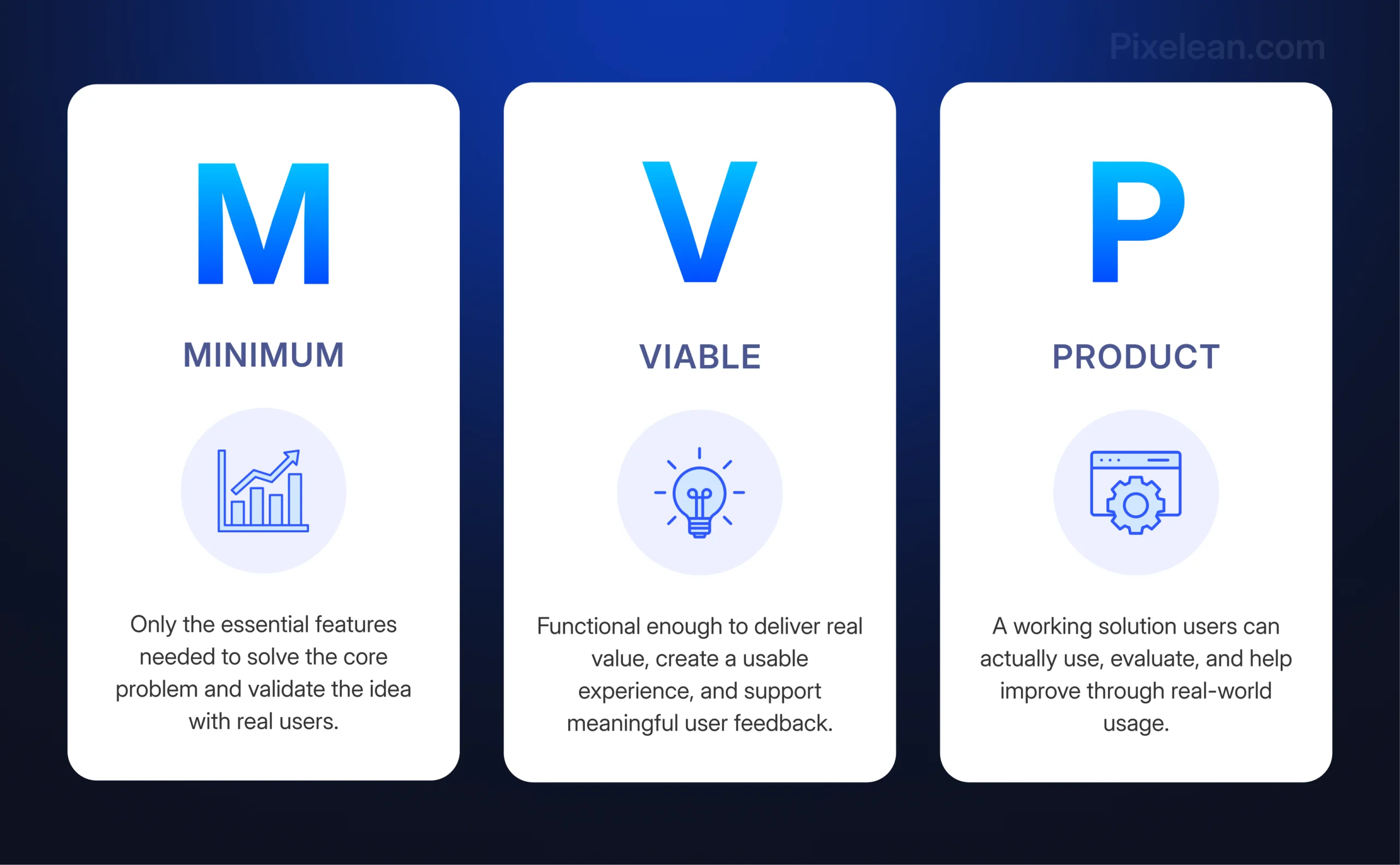
An MVP is the smallest version of your product that still teaches you something true. Not a demo. Not a prototype that sits in a drawer. A real, usable thing that a real person can try, so you can find out whether anyone wants it before you bet the house on it.
Here’s why that matters. According to CB Insights, the leading cause of startup death is running out of capital (70% of failures), but that’s just where the story ends. The more telling reason is poor product-market fit, which shows up in 43% of shutdowns (CB Insights, 2026). Translation: most failed startups didn’t run out of money building the wrong thing. They built the wrong thing, and then ran out of money.
An MVP is your insurance against that. It’s the cheapest way to be wrong.
So when you go looking for a company to build one, you’re not hiring coders. You’re hiring people who understand that the whole point is to learn quickly. Keep that in your head. We’ll come back to it about nine times.
Why does the company you pick matter so much?
Because the right partner saves you from your own enthusiasm. Founders fall in love with features. A good MVP development company talks you out of most of them, which is exactly what you’re paying for. Remember that 43% product-market-fit number (CB Insights, 2026)? The job of your build partner is to drag that number down for you, not up.
A strong company does three things. It helps you figure out the one feature that proves your idea. It builds that feature well enough to put in front of users. And it gets out of the way so you can read the results.
That’s it. Everything else is decoration.
A weak company does the opposite. It says yes to everything, quotes you a giant timeline, and hands you a beautiful product four months later that you’ve never once shown a customer. You’ll feel productive the whole time. That’s the trap.
What does an MVP development company actually do?
It turns your idea into something people can use, and it does the parts of MVP app development you can’t. Most MVP development services cover roughly the same set of things, so the question isn’t whether a company offers them; it’s whether it’s any good at them.
Here’s the short list:
- Figures out what to build first. Discovery, scoping, ruthless cutting.
- Designs it. Wireframes and a clickable flow before anyone writes code.
- Builds it. Usually in short cycles, so you see progress every week or two.
- Tests it. So your first user isn’t your QA department.
- Helps after launch. Because the launch is the start, not the finish.
Notice what’s not on that list: a 40-page strategy document, a brand workshop, a five-year roadmap. If a company leads with that stuff before you have a single user, be suspicious. You’re trying to learn, not to look impressive at a board meeting.
How do you spot a good one?
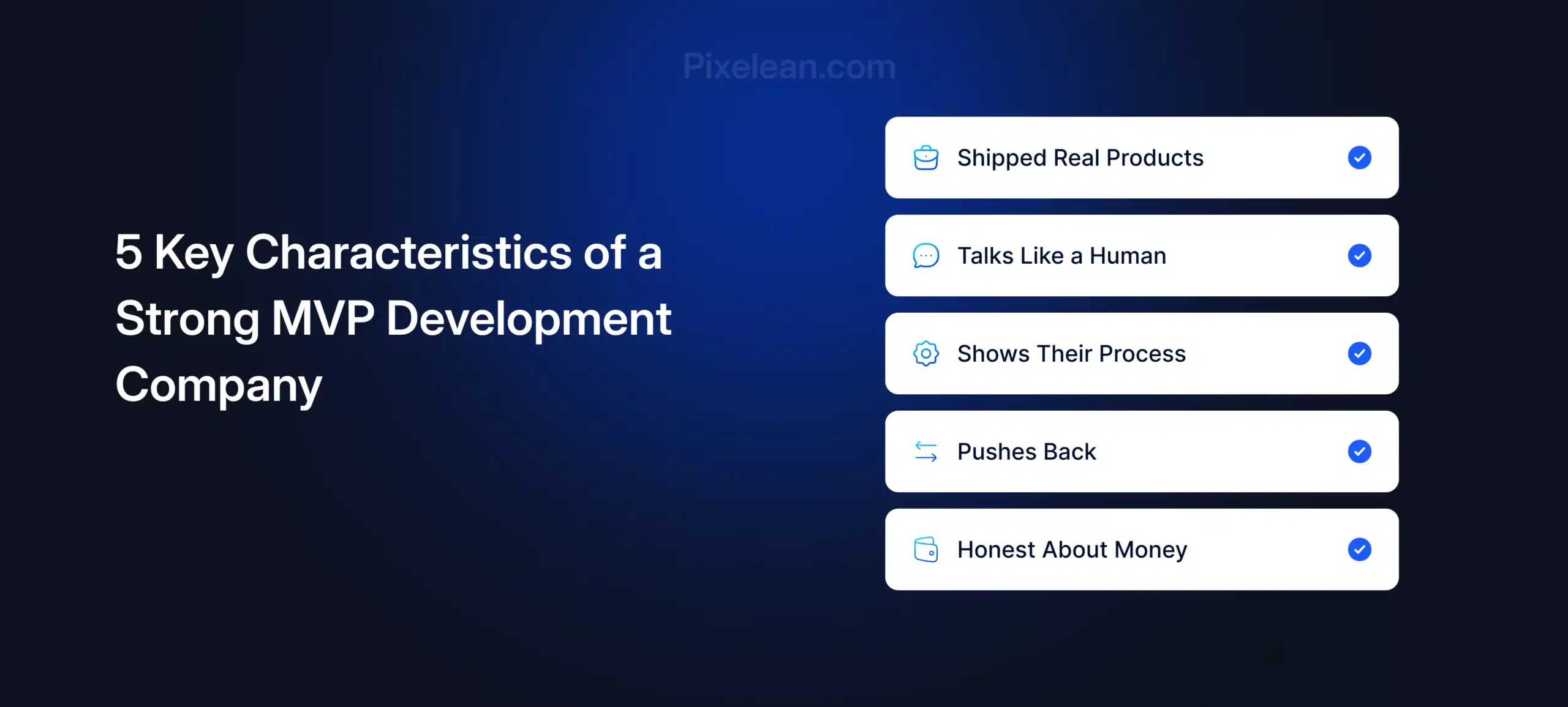
You look for a company that wants to build less than you do. That’s the whole trick, and almost nobody tells you this part.
Beyond that, a handful of things actually predict whether a partnership works:
- They’ve shipped something like yours. Not identical, but close enough that they’ve already hit the weird problems. Ask to see real, live products. Not mockups. Things you can open on your phone right now.
- They talk to you like a person. If the sales call is full of words like “synergy” and “holistic ecosystem,” imagine eight months of that. Clear communication on the first call is the single best predictor of clear communication later.
- They show their process. A real MVP software development company can tell you, in plain language, what happens in week one, week four, and week ten. Vague answers here mean vague work later.
- They argue with you. A partner who pushes back on your feature list is worth more than one who nods at everything. Yes, people are easy to hire and expensive to keep.
- They’re honest about money. Clear pricing, clear scope, clear answer about what happens when you want a change. Surprises in the contract become surprises in the invoice.
Five things. If a company nails all five, the rest of the details mostly sort themselves out.
What should you ask before you sign anything?
Ask the questions that make a weak company squirm. Most founders ask about price and timeline and stop there, which tells you almost nothing, because everybody quotes a nice price and a nice timeline.
Here are the questions worth asking instead:
- Can I see three products you’ve built that are actually live?
- What’s the smallest version of my idea you’d recommend, and what would you cut?
- Who, specifically, will be working on this, and can I talk to them?
- What happens when I want to change something mid-build?
- What do you do after launch?
- Can I call two of your past clients?
That last one matters more than the whole pitch deck. A past client will tell you in five minutes what a sales page hides in five paragraphs. If a company gets twitchy about references, you have your answer.
The MVP development process, in five plain stages
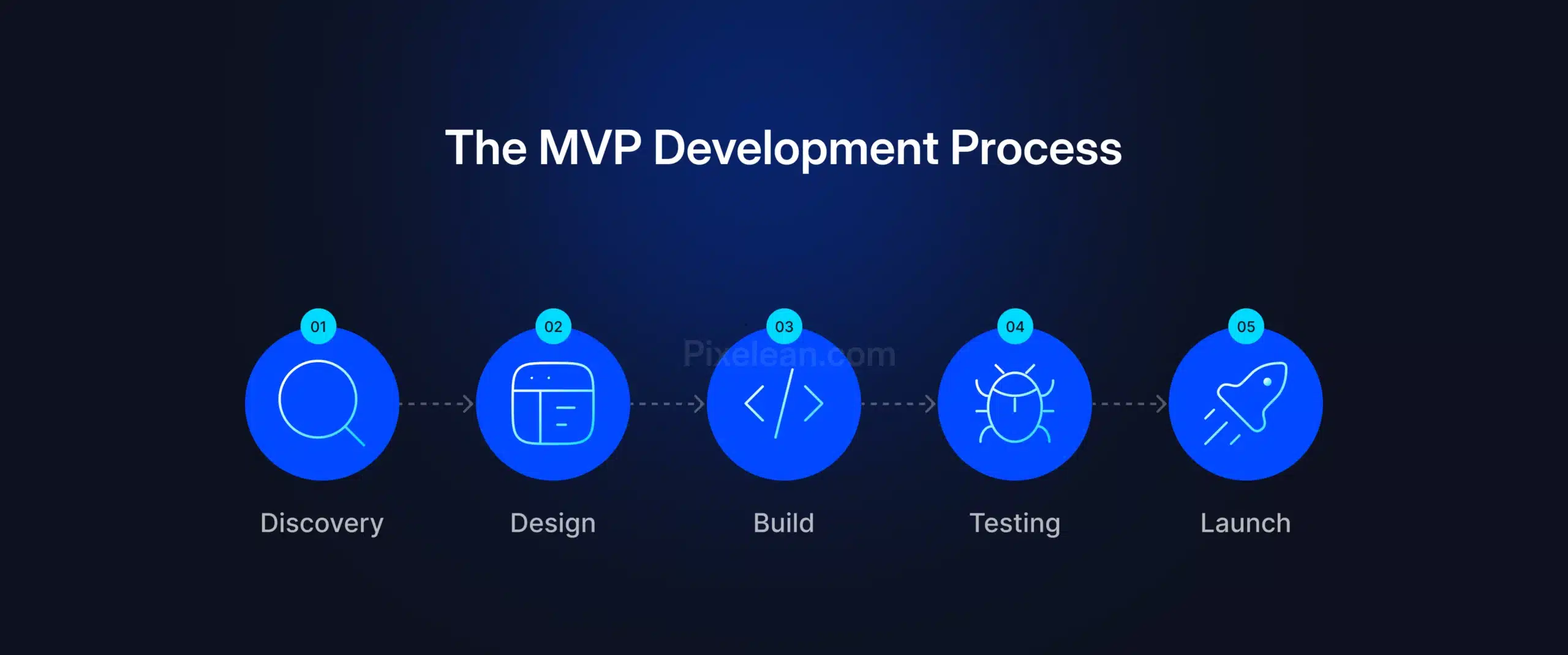
It’s five stages, and most MVP development companies run the same ones, so don’t let anyone dress them up as a secret method. Knowing the shape of it means you can tell when things are going sideways.
- Discovery and planning. You agree on what you’re building and, more importantly, what you’re not building.
- Design. Wireframes and a clickable prototype. You should be able to click through your app before a line of code exists.
- Build. Short cycles. You see something working every week or two, not in one big reveal at the end.
- Testing. Someone tries to break it on purpose so your users don’t break it by accident.
- Launch and feedback. You ship, you watch what real people do, and you decide what’s next based on what they actually did.
If a company can’t explain those five stages in plain English, that’s not a small thing. The way they describe the work is a preview of the work.
Location matters, but less than you’d think
A little, but less than people think. If you’re based stateside, an MVP development company in the USA may line up with your time zone and working week, and that’s easier, because the average MVP takes 4 to 5 months, and you’ll be talking a lot. Same hours, same working week, fewer emails that sit overnight.
But location is a tie-breaker, not a deal-breaker. A great team eight time zones away beats a mediocre one down the street every single time. Plenty of products get built across continents without anyone meeting in person. What you’re really buying is communication, and communication is a skill, not a postcode.
So weigh it. Then weigh everything else more.
The mistakes that quietly drain your budget
The expensive ones all rhyme, and the most expensive is hiring on price alone. Budget is real, nobody’s pretending otherwise. But the cheapest quote often turns into the most expensive project, because you pay twice: once for the bad version, and again to fix it.
A few others that bite founders:
- Skipping the reference check. You’d check references for a babysitter. This is a six-figure babysitter.
- Confusing busy with progress. Lots of meetings and screenshots can hide the fact that no real user has touched your product yet.
- Building everything. Every extra feature is more time, more cost, and more places to be wrong before you’ve learned anything.
- Going quiet on communication. If updates dry up in month two, they won’t magically return in month four.
None of these is a clever mistake. They’re the obvious ones, made by smart people who were in a hurry. Slow down for one week of homework, and you’ll save yourself months.
What does an MVP cost in 2026?
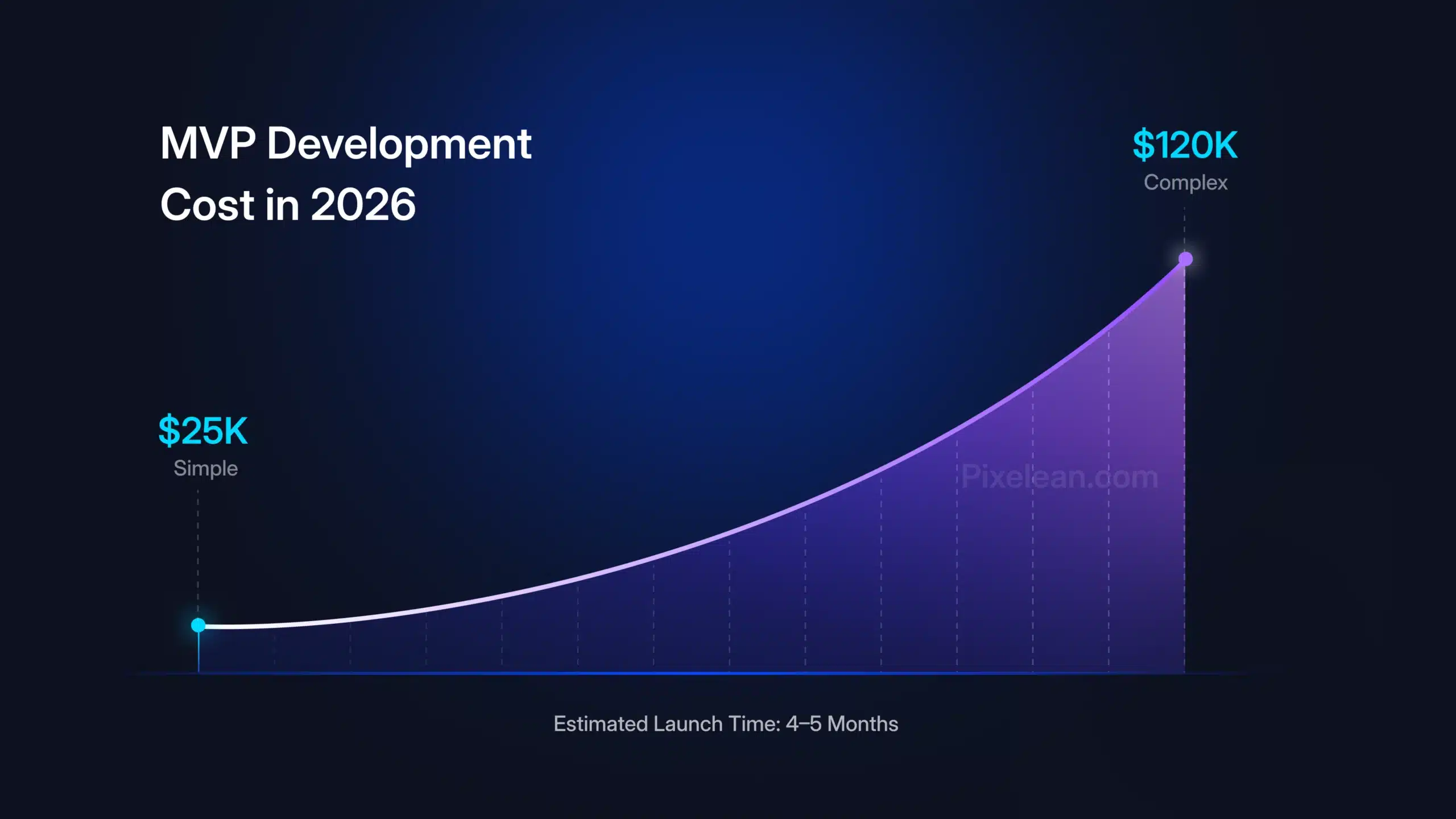
Roughly $25,000 to $120,000, depending on how complicated your idea is and who builds it (industry estimates, 2026). A simple app on the low end, something with payments, accounts, and real complexity toward the top. Most teams quote a time to market of about 4 to 5 months.
Those are ballpark numbers, and anyone who gives you an exact figure before understanding your product is guessing. The useful question isn’t “what’s the cheapest?” It’s “what’s the smallest thing we can build that tells us if this works?” Answer that, and the cost answers itself.
And here’s the part worth sitting with. Against a 43% product-market-fit failure rate (CB Insights, 2026), the real cost isn’t the build. It’s spending all of it on the wrong build. A good company makes that mistake cheaply. A bad one makes it your whole budget.
Frequently asked questions
How long should an MVP take to build?
Most MVPs reach the market in about 4 to 5 months, based on 2026 industry estimates. Anything quoted at over a year usually means the scope is too big. The point of an MVP is speed, so if the timeline looks like a full product, push back and ask what can be cut.
Should I hire a company or build it in-house?
If you already have a strong technical team, in-house can work. If you don’t, a specialist company is usually faster and cheaper than hiring engineers from scratch. With 43% of startups failing on product-market fit (CB Insights, 2026), speed to a real test matters more than owning the code on day one.
What’s the most common MVP mistake?
Building too much. Founders pack in features to feel ready, which delays the only thing that counts: putting the product in front of real users. The whole value of an MVP is learning early, and every extra feature pushes that lesson further away.
How do I know if an MVP development company is any good?
Look at live products they’ve shipped, talk to two past clients, and watch whether they push you to build less. A company that helps you cut scope is protecting you from the 43% product-market-fit failure rate (CB Insights, 2026), even if it costs them a bigger contract.
Does an MVP need to look polished?
It needs to work and be usable, not win design awards. Polish comes after you know people want the thing. Spending heavily on visual perfection before validation is one of the quieter ways founders burn a budget.
So what do you actually do?
Start with one week of homework. Choosing an MVP app development company really comes down to that: make a short list of companies that have shipped real products. Get on a call with each. Ask the smallest version of the question and listen to who answers it honestly. Check two references. Then pick the team that wants to build less than you do, communicates like a human, and tells you the truth about money.
Do that, and you’ve already dodged the mistake that kills nearly half of all startups. The rest is just building.
If your MVP includes a mobile app, read our complete guide to mobile app design services for startups
Ready to build yours?
We’re Pixelean, a UI/UX design team for startups and founders. We turn fuzzy MVP ideas into clickable prototypes, SaaS dashboards, and mobile apps you can put in front of real users, fast, so you find out what works before you build the whole thing.
Book a free 30-minute call and walk away with a clear scope for your MVP. What to build first, what to cut, and how soon you can be in front of real users.