
Search “website redesign cost” and you get a number. Anywhere from $3,000 to $250,000, depending on which article you land on. They are all technically right. They are all answering the smaller question.
The bigger question is what a redesign can cost you. A site that ranks well today can lose most of its search traffic the week after launch, because the URLs changed and nobody planned the redirects. That loss shows up in Google Search Console about three weeks later. It never shows up on the quote.
There is also the scope problem. The word “redesign” covers at least three different projects: a visual refresh, a structural redesign, and a full rebuild. Getting quotes before you know which one you need is how a $12,000 project turns into $60,000 halfway through.
So, how much does a website redesign cost? Honestly, it depends on which of those three you actually mean. We will get to real numbers in a minute.
There is a new wrinkle in 2026, too. AI site builders will hand you a redesign for about $10 a month, and for the build itself, that is real. The cheap part was never the problem. The expensive part is the traffic your current site already earns, and an AI reskin does nothing to protect it. Full disclosure. Pixelean designs and builds websites, so read this as a working studio explaining its own pricing logic, not a neutral survey. We will show you the numbers, and the one line item that quietly costs the most.
Key takeaways
- A website redesign runs from about $5,000 for a visual refresh to $150,000 and up for a full rebuild. The driver is the number of unique page templates, not the page count.
- Clutch’s review data puts the average web design project at about $38,000, though most come in under $10,000 (Clutch).
- Content is the line most people forget. In our experience it is 10 to 25 percent of the budget.
- The biggest cost is the one nobody quotes: organic traffic lost to changed URLs and missing redirects.
- A refresh, a redesign, and a rebuild are three different projects. Most businesses need one of the first two.
Refresh, redesign, or rebuild
You know the site needs work. You are just not sure how much. The website refresh vs redesign question is the one that decides your budget, so start there.
Here is the difference in a nutshell.
A visual refresh changes the surface: colors, type, imagery, a bit of layout. The structure, the URLs, the CMS, and the content all stay put. It is the right call when the site works but looks tired. Figure $5,000 to $15,000, three to six weeks, and almost no SEO risk, because nothing moves.
A structural redesign is a bigger job. You are changing the information architecture, the navigation, the page templates, and the way people move through the site. The platform and most of the content usually stay. This is what you want when visitors cannot find things, or the site no longer matches what you sell. Figure $15,000 to $60,000 and eight to sixteen weeks. The SEO risk is real here, because URLs move and someone has to map them.
A full rebuild replaces everything, usually including the platform. The domain stays, and whatever content survives the move. You do this when the current site is unmaintainable, the platform is wrong, or the business changed underneath it. Figure $60,000 to $150,000 and up, four to eight months, and the highest SEO risk of the three.
| Type | What changes | Cost | Timeline | SEO risk |
| Visual refresh | Look only | $5,000 to $15,000 | 3 to 6 weeks | Low |
| Structural redesign | Structure and design | $15,000 to $60,000 | 8 to 16 weeks | Medium |
| Full rebuild | Everything | $60,000 to $150,000+ | 4 to 8 months | High |
We are not the only ones who have watched a small job get away from someone. A widely read thread on Hacker News is titled, plainly, I Regret My $46k Website Redesign, where a modest refresh turned into a $46,000 project once the scope was never pinned down. It is worth ten minutes before you sign anything.
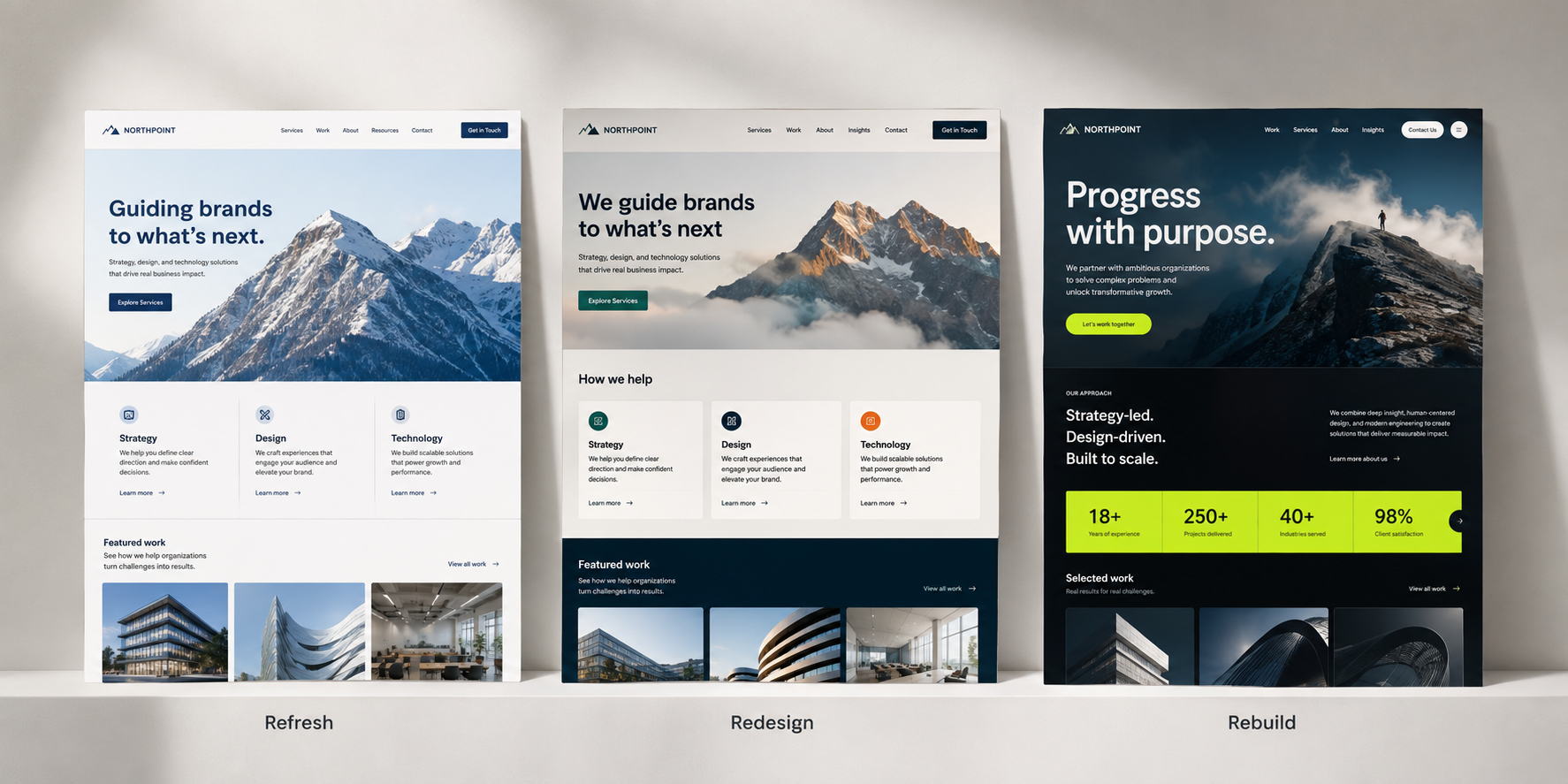
The pattern we see is simple. Most people who ask for a rebuild need a structural redesign. Most people who ask for a redesign need a refresh. The diagnosis is worth more than the quote. We use the same three-way split when clients ask how much a rebrand costs.
What actually drives the price
The cost to redesign a website comes down to five things, and page count is not really one of them.
- Unique page templates, not page count. A 60-page site built on 8 templates costs less to design than a 20-page site that needs 15 different layouts. Agencies price templates. So ask any quote one plain question: how many unique templates does this include?
- Content migration. This is the line people forget, and in our experience it is 10 to 25 percent of the budget. Moving 200 blog posts, reformatting each one, and checking every internal link is real work. Guess who ends up doing it at 11pm.
- Platform migration. Staying on your current CMS is cheaper than moving off it. A platform change adds real money before anyone counts the plugin features that have to be rebuilt from scratch.
- Custom functionality. Every integration, calculator, booking system, portal, or gated area is a separate build, and complex information architecture and heavy motion design belong in the same bucket. They are effort, not decoration, and this is where estimates quietly break.
- Accessibility. Designing to WCAG 2.2 AA is the baseline expectation now, and accessibility at level AA is a legal floor in much of the world, not an extra. The European Accessibility Act took effect in June 2025 and reaches businesses outside the EU that sell into it (European Accessibility Act). Building it in costs a fraction of bolting it on later.
We go deeper on how studios price all of this in our take on what to expect from web design agency pricing. If a platform move is on the table, our Webflow vs WordPress piece lays out the tradeoffs.
Website redesign cost by scope
Here is roughly what website redesign pricing looks like by the size of the site. These are our design and build ranges. Content writing, photography, and maintenance sit outside them.
| Scope | Templates | Cost | Timeline |
| Visual refresh | Existing | $5,000 to $15,000 | 3 to 6 weeks |
| Small business site (10 to 20 pages) | 5 to 8 | $15,000 to $40,000 | 8 to 12 weeks |
| Mid-market site (30 to 75 pages) | 8 to 15 | $40,000 to $90,000 | 12 to 20 weeks |
| Enterprise (100+ pages) | 15+ | $90,000 to $250,000+ | 5 to 9 months |
For a sanity check against the wider market, Clutch’s review data puts the average web design project at about $38,000, though most come in under $10,000, across a range of $2,000 to $100,000 (Clutch, 2026). Redesigns tend to sit above that average, because the migration work is on top of the build.
What each tier buys, in plain terms:
- Visual refresh. New colors, type, imagery, and component styling on the existing structure. No new IA, no URL changes, no platform work.
- Small business redesign. Discovery, a new information architecture, five to eight templates, responsive design, CMS setup, basic content migration, and a redirect plan. This is the website redesign cost for small business that most owners are picturing when they start asking around.
- Mid-market redesign. Everything above, plus user research, more templates, custom functionality, integrations, a design system, and a full content migration.
- Enterprise. Multi-stakeholder discovery, governance, compliance review, multi-region or multi-language needs, and a migration plan that runs alongside a live site.
A lot of this work lives in the UI/UX design, not the code.



Planning a redesign on a site that already ranks?
Send us the URL. We will tell you what is at risk and what it takes to protect it.
Who you hire changes the number
The same redesign costs wildly different amounts depending on who builds it. Here is the honest version.
| Provider | Cost range | You get | You do not get |
| DIY or AI builder | $0 to $2,000 (AI from ~$10/mo) | A live site | Strategy, SEO planning, custom work |
| Freelancer | $3,000 to $15,000 | Design and build | Redirect strategy, research, cover if they vanish |
| Boutique agency | $15,000 to $60,000 | Full process, SEO-aware migration, handoff | Enterprise governance |
| Large agency | $60,000 to $250,000+ | Depth, compliance, capacity | A senior person on your project daily |
An AI builder is the new bottom rung. It is fast, it is cheap, and it will hand you a live site in an afternoon. What it will not do is ask where your old URLs should point.
The real gap between a freelancer and an agency on a redesign is not visual quality. Plenty of freelancers do lovely work. The gap is whether anyone maps your existing URLs before the new site goes live. That one task is the difference between keeping your rankings and starting your SEO over from zero. It is also the task an AI builder skips entirely.
The cost nobody quotes for
Why would a redesign hurt your traffic? It is a better site. That is the reasonable assumption, and it is where the money leaks out.
A redesign changes URLs. Search engines have your old URLs indexed, along with the rankings and links those pages earned over the years. If the new site does not tell Google where each old page went, that value does not carry over. It disappears.
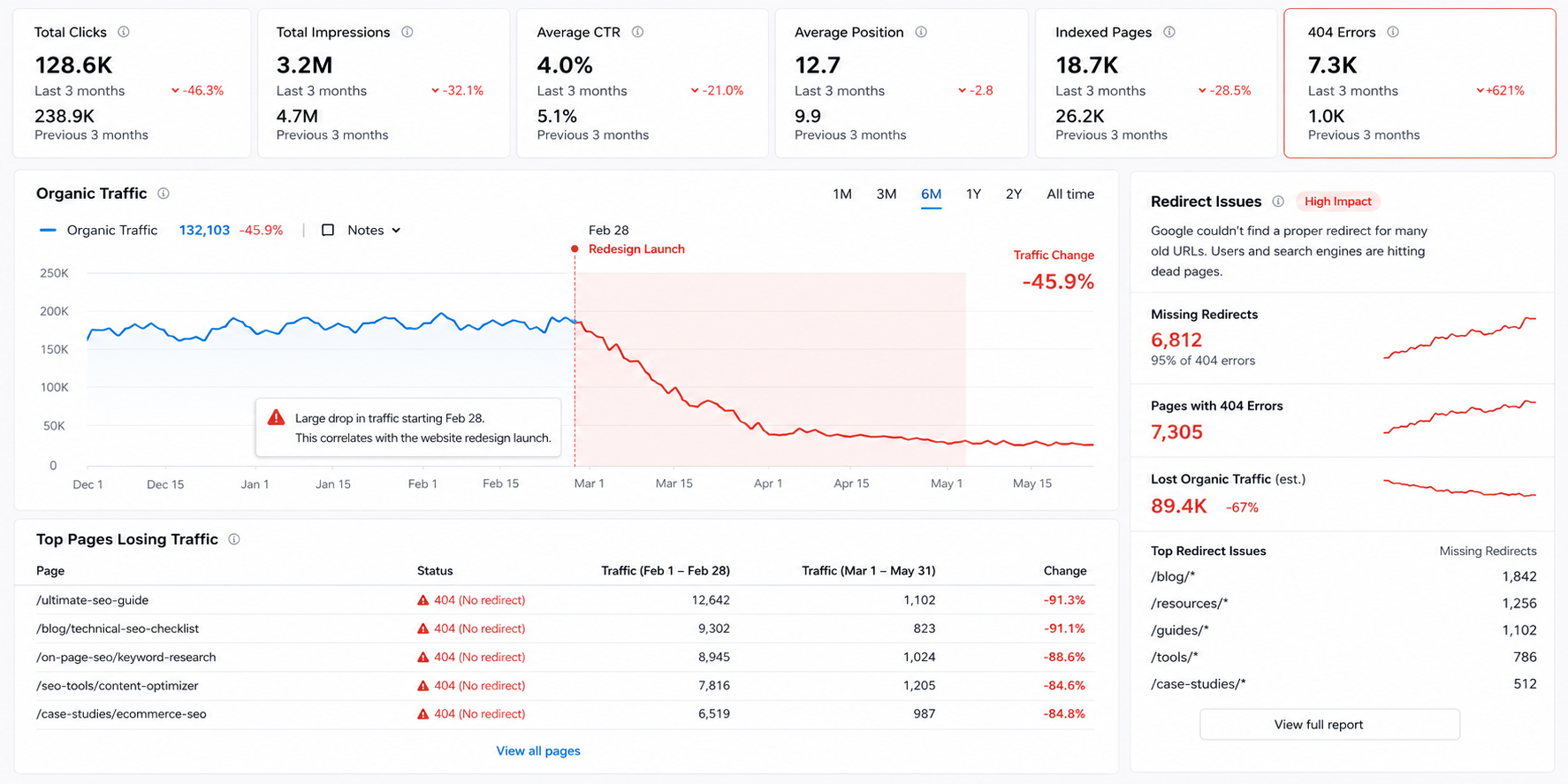
Here is what actually goes wrong:
- The URLs change and nobody builds a redirect map.
- High-performing pages get cut because they looked dated in a content audit.
- Titles and headings get rewritten for style, and the exact words that were ranking come out.
- Internal links still point at the old structure.
- The new site is heavier than the old one, and Core Web Vitals slip.
- Three pages that each ranked get merged into one that ranks for none of them.
What it costs: Traffic loss after a sloppy migration is usually measured in months, not weeks. For a business that gets real leads from search, that gap can cost more than the whole redesign did.
A proper migration is not complicated. It is just work that has to be scoped in on purpose:
- A full crawl of the existing site before anything moves.
- An export of current rankings and your top-performing pages.
- A one-to-one redirect map from every old URL to its new home.
- Preserved titles and headings on the pages that rank.
- An internal link audit after launch.
- Google Search Console monitoring for six to eight weeks after go-live.
Ask any agency quoting your redesign whether that list is in scope. If it is not, the quote is incomplete, whatever the number on it says.
We have watched this happen on our own site. We changed a blog URL structure without checking every redirect, and an article that had been sitting on page three dropped out of the index completely until we confirmed the redirect. The fix took ten minutes. Noticing it had happened took weeks.
There is a public version of this that is much larger. In 2025 the Australian Bureau of Meteorology first said its new website cost $4.1 million, then disclosed the full figure was $96.5 million once the build and security testing were counted (ABC News, November 2025). The quote told everyone what the redesign cost. It did not tell them what it would cost.
The hidden costs
Beyond the design and build quote, a few website redesign hidden costs show up reliably. Budget for them now, not at 11pm on launch week.
- Content writing. If the copy needs rewriting, figure $100 to $300 a page, or 10 to 25 percent of the project.
- Photography and assets. A new look usually wants new images. Anywhere from $1,000 to $15,000, depending on scope.
- Plugin and license fees. Premium themes, form tools, booking systems, and integrations carry annual costs that outlive the project.
- Staff time. Someone on your side reviews every page, gathers content, and approves rounds. On a mid-size redesign that is weeks of somebody’s calendar.
- Post-launch fixes. Every launch produces a snag list. Find out now if those fixes are included, or billed on top.
- Ongoing maintenance. Figure $500 to $3,000 a month, depending on the platform and scope. Ask before you sign, not after.
The rule of thumb we give clients: add 20 to 30 percent on top of the design and build quote for everything around it. In our experience that turns a nasty surprise into a line you already planned for.
How to keep the number down
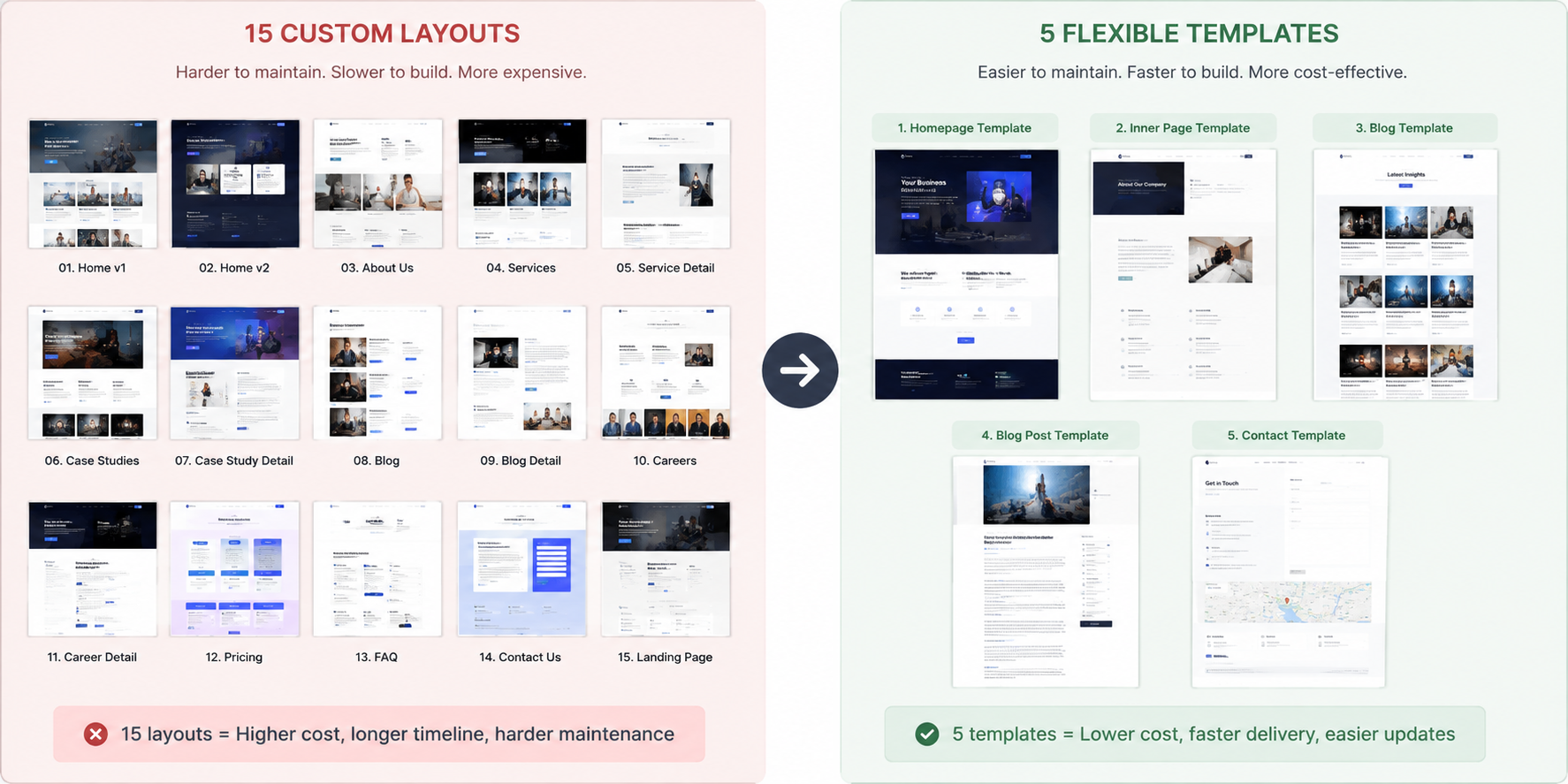
You can move the number without cutting corners. Most of the savings are in scope discipline, not in hunting for a cheaper builder. The pattern we see:
- Standardize templates. Five well-built templates that flex will beat fifteen bespoke layouts, and it is the single biggest lever on design cost.
- Lock the copy before design starts. Designing around “content to come” is how projects stall and bills grow. Words first, then layout.
- Phase the nice-to-haves. Launch the site, then add the calculator, the portal, the heavy animation. A shorter first scope is a cheaper, faster first scope.
- Use AI for the grunt work. Content migration, image resizing, and first-draft alt text are routine jobs where AI genuinely saves hours. Keep people on the redirect map and the design.
- Ask for an itemized quote, and ask how many templates it covers. A number you can read line by line is a number you can trust.
- Hand over a one-page brief before anyone quotes: your goal, your templates, your platform, your integrations, whether the content is ready, and your launch date. Quotes built from a brief are real. “Starting from” pricing is not.
None of this is about paying less than the work is worth. It is about not paying for scope you never needed.
When it’s actually time to redesign
There is a real case for redesigning, too. The trigger should be a business reason, not a calendar date or a bad mood. In our experience a redesign earns its cost when one of these is true:
- The site no longer matches what you sell. You have added products, moved upmarket, or changed who you serve, and the site still describes the old company.
- People cannot find things. Support keeps answering questions the site should answer, or the analytics show visitors bouncing off the navigation.
- The platform is holding you back. You cannot publish a page without a developer, or the CMS fights you every time you make an edit.
- It is slow and you can prove it. Core Web Vitals are poor and it is costing you rankings or conversions, not just patience.
- It fails on a phone or on accessibility. Most of your visitors are on mobile the old site never planned for, or it cannot meet the WCAG AA bar your market now expects.
If one of those is true, you have a business case. If none is, keep your money and read the next section.
When not to redesign
Every article like this one assumes you should redesign. Here are three times you should not.
Your traffic problem is a content problem. If nobody is finding the site, a prettier site will not change that. A redesign just makes a page nobody visits look nicer. Sort out how people find you first.
Your conversion problem is a message problem. If people arrive and leave, look at what the page says before you change how it looks. Rewriting a headline is a week. A redesign is three months. There are usually cheaper fixes hiding in the copy and the user experience.
The site works and you are bored of it. This is the most expensive item on the list, and it is more common than anyone admits. A site that converts is an asset. Boredom is not a business case. And if the honest reason is boredom, an AI reskin is now cheap enough to be tempting. Cheap still does not make it a good idea.
You are not the only one who is skeptical. There is a long-running argument, including a well-read piece bluntly titled UI redesigns are mostly a waste of time, that plenty of redesigns exist to get the executive who sponsored them promoted, not to help anyone use the site. That is cynical. It is also, sometimes, true.
Before you commission anything, run a quick diagnostic:
- Where is your traffic coming from, and is there enough of it?
- Where do people drop off, and on which page?
- Which pages already convert, and why?
- Is the problem visible in analytics, or only in your opinion of the design?
If you cannot point to a number the redesign should move, you are not ready to brief one.
How Pixelean approaches a redesign
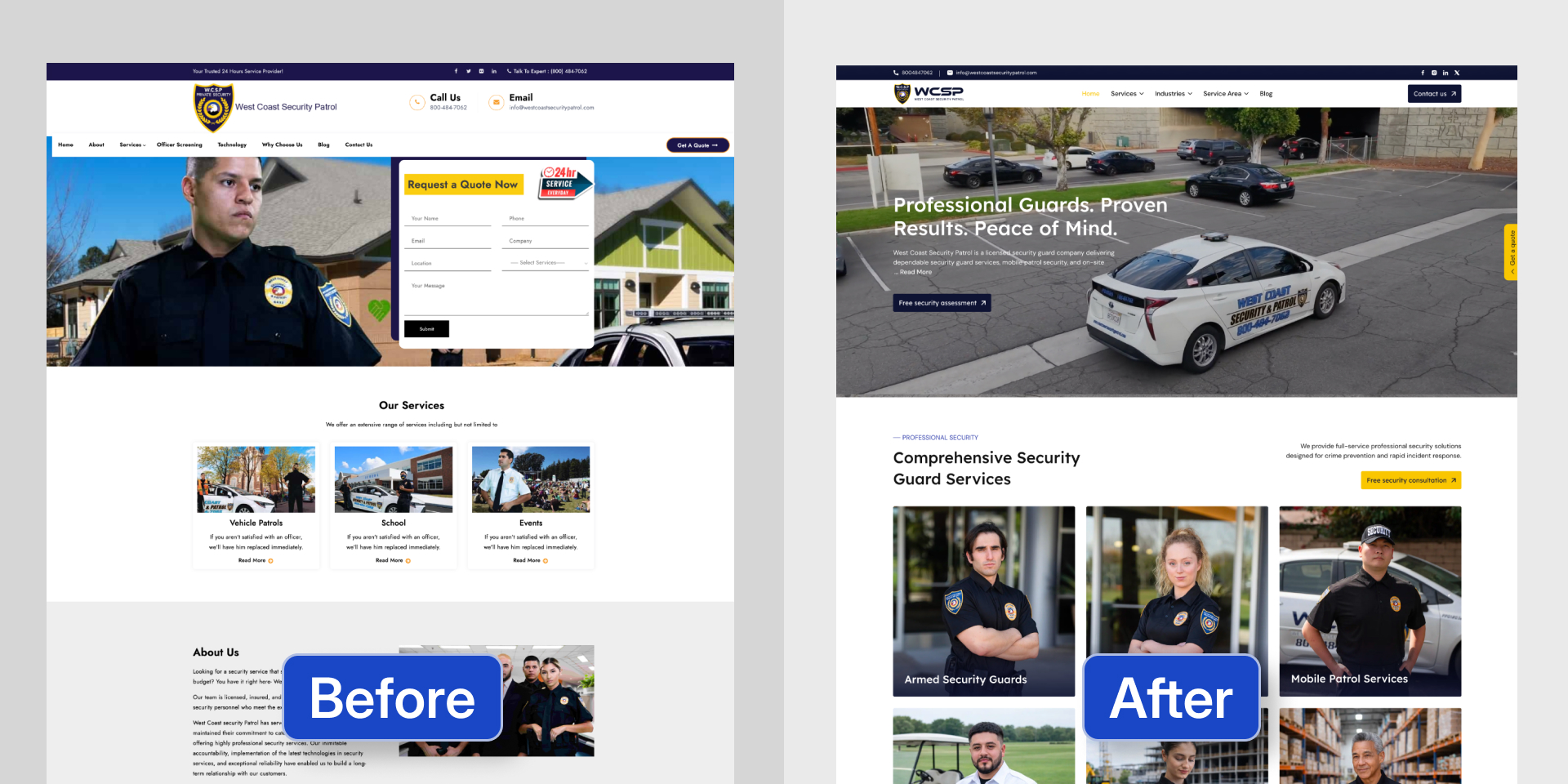
Full disclosure again: we do this work, so weigh that. Here is how we run it.
- We start by crawling the existing site and exporting current rankings before any design begins.
- The redirect map is part of the build, not an afterthought.
- Pages that rank keep their titles and headings unless there is a good reason to change them.
- We watch Google Search Console for six to eight weeks after launch, because that is when problems surface.
- We define scope before we give a number. No “starting from” pricing.
If that is the way you would rather do it, our website development team can take it from the URL.
Frequently asked questions
How much does a website redesign cost in 2026?
A visual refresh costs $5,000 to $15,000. A structural redesign of a small business site runs $15,000 to $40,000. Mid-market sites run $40,000 to $90,000, and enterprise rebuilds start around $90,000. For context, Clutch’s review data puts the average web design project at about $38,000, with most under $10,000 (Clutch, 2026). Cost is driven by the number of unique page templates, not the total page count.
What is the difference between a website refresh and a redesign?
A refresh updates the visual layer, meaning colors, type, imagery, and component styling, while leaving the structure, the URLs, and the platform alone. A redesign rebuilds the information architecture, the navigation, and the page templates. Refreshes cost less, take less time, and carry almost no SEO risk, because the URLs do not move.
Will a website redesign hurt my SEO?
It can, and it is the most commonly overlooked risk in the whole project. When URLs change without a one-to-one redirect map, the rankings and links those pages earned do not transfer. Traffic loss usually appears two to three weeks after launch and can take months to recover. A proper migration plan prevents it.
How long does a website redesign take?
A visual refresh takes three to six weeks. A small business redesign takes eight to twelve weeks. A mid-market redesign takes twelve to twenty weeks. Enterprise rebuilds run five to nine months. Timelines depend heavily on how quickly content and feedback arrive from your side.
What hidden costs come with a website redesign?
Content writing at $100 to $300 a page, photography, plugin and license fees, internal staff time for reviews and content gathering, post-launch fixes, and ongoing maintenance at $500 to $3,000 a month. Budget 20 to 30 percent on top of the design and build quote.
How often should a website be redesigned?
Most businesses benefit from a structural redesign every three to five years, with smaller refreshes in between. The better trigger is a business one, not a calendar one. Redesign when the site no longer matches what you sell, when visitors cannot find what they came for, or when the platform limits what you can ship.
Sources
- Clutch, Web Design Company Pricing Guide, 2026 (clutch.co/web-designers/pricing).
- ABC News, Bureau of Meteorology website cost, November 2025 (abc.net.au).
- European Accessibility Act, Directive (EU) 2019/882