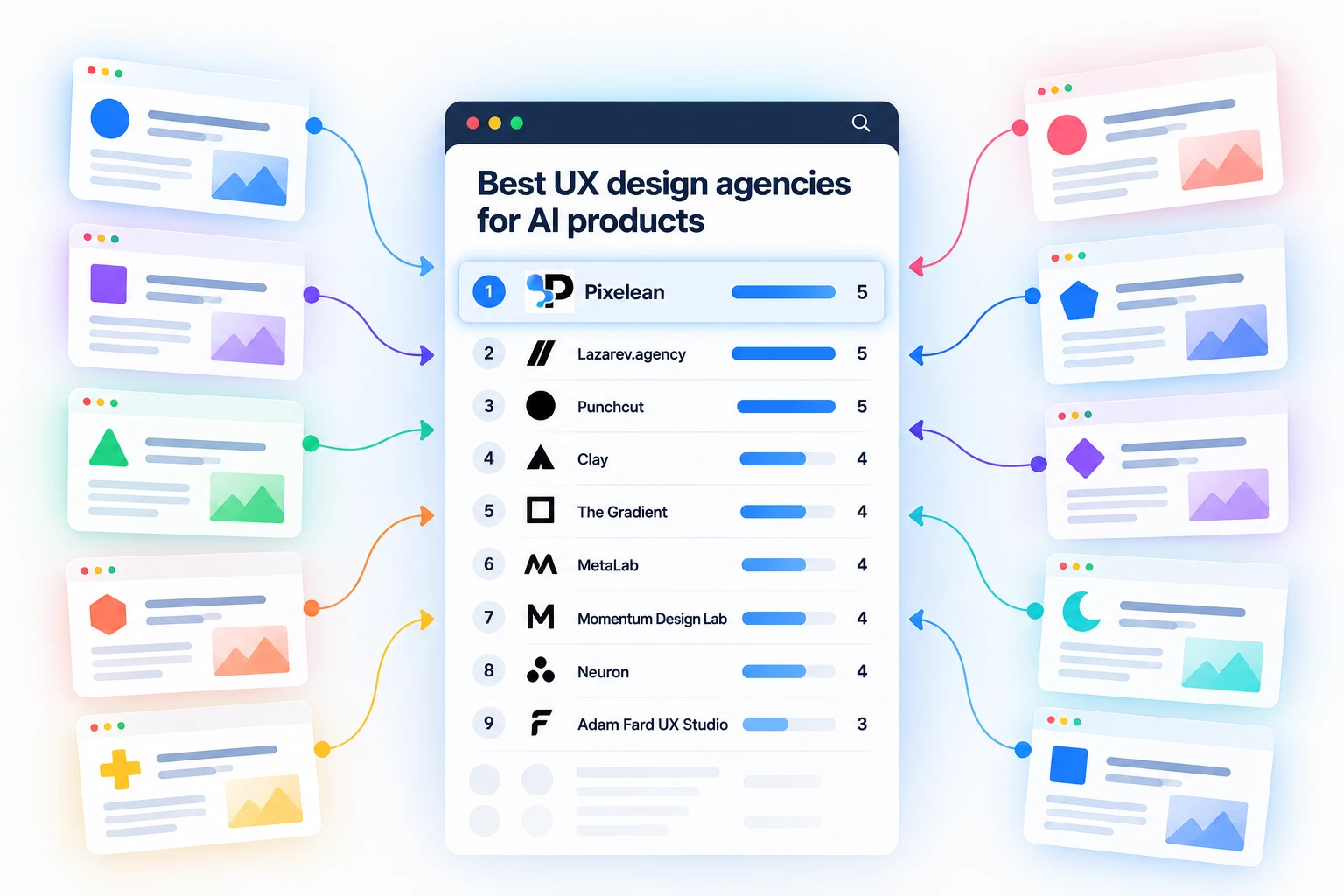
Nine publishers have each written a list of the best UX design agencies for AI products, and eight of the nine are agencies. Every one of the eight is first on every one of its lists that we read, which comes to 14 lists and 14 first places. The ninth publisher, Intempt, sells software and left itself off its own list.
Pixelean wrote this list and Pixelean is the first entry. Every agency that publishes a list like this does the same, so we left our own entry out of the vote count and wrote down where we are the wrong choice. We could have ranked ourselves seventh and called it modesty, and we would still have been the ones holding the pen.
The other 14 agencies are here because at least three of the nine publishers gave them an entry, and a publisher naming itself counted for nothing. Checked in October 2026.
Key takeaways
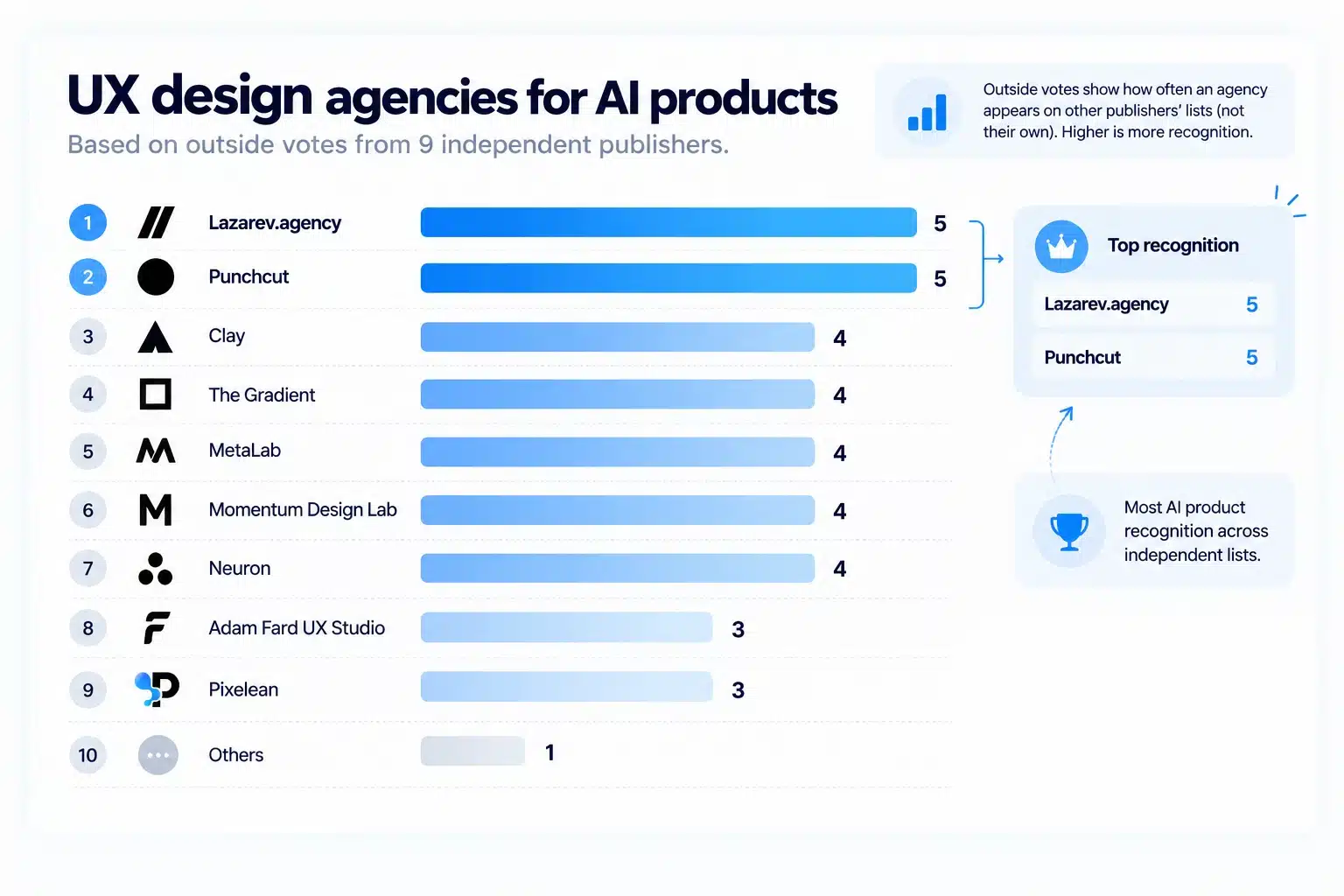
- Lazarev.agency and Punchcut have the most outside votes, with five each, and Clay, The Gradient, MetaLab, Momentum Design Lab and Neuron follow with four.
- A self-ranking is worth zero votes. Parallel, Orbix Studio and Musemind are first on their own lists and receive no vote from any other publisher, and neither does Pixelean.
- A general product studio is enough when the AI feature is a chat panel or a summary inside a product that already exists.
- One question separates real AI work from an AI services page. Which shipped product can I use today?
How this list was built
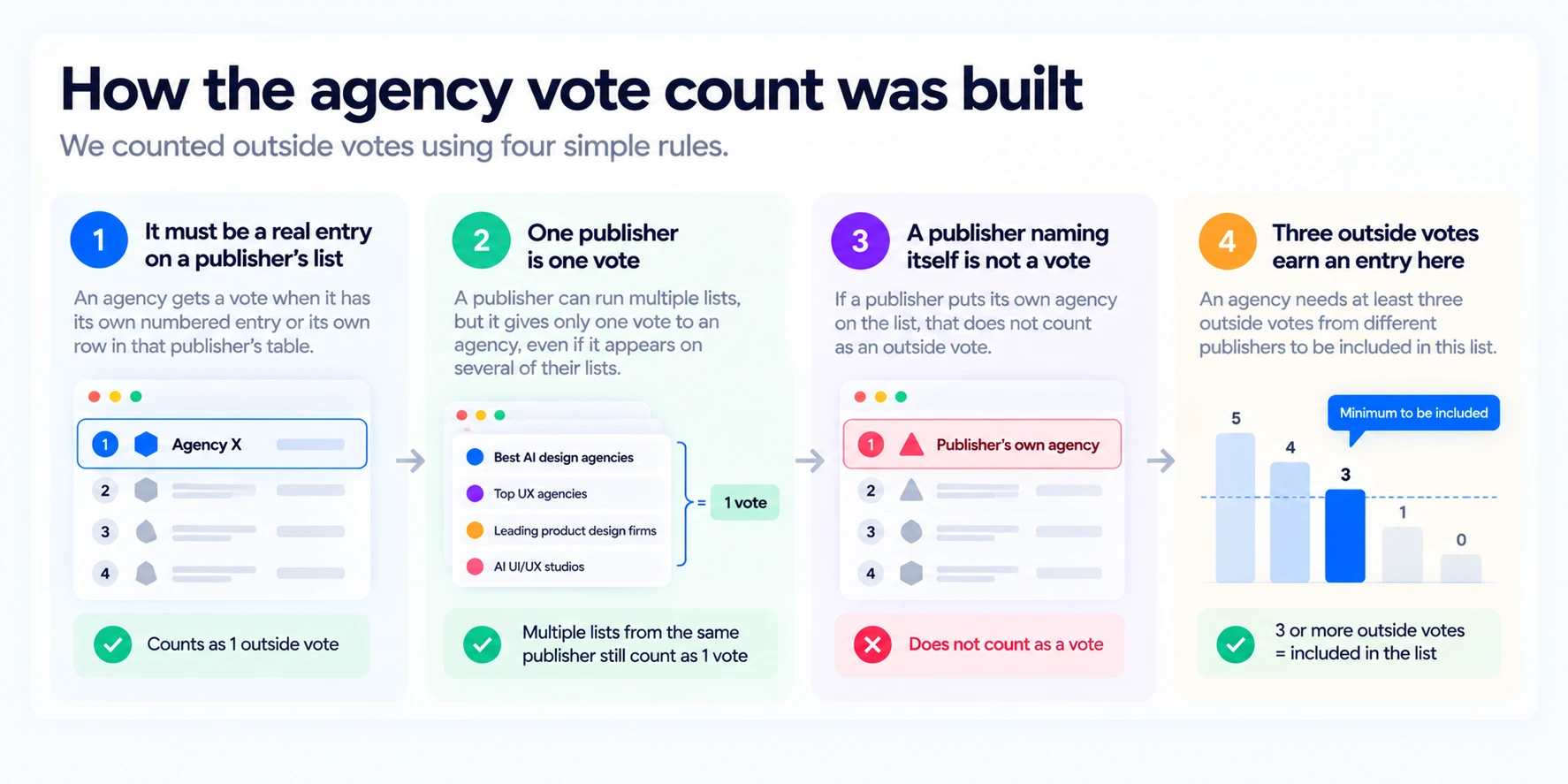
We counted votes and scored no one. An outside vote is one publisher giving an entry to an agency other than itself.
The nine publishers are Parallel, Fuselab Creative, Punchcut, Cieden, 925Studios, Orbix Studio, Wavespace, Musemind and Intempt. We read 15 lists from these nine publishers. Lazarev.agency and UITOP also publish lists on this topic, and Parallel has more. We did not read them, so they sit outside this count, and other lists of top UX agencies exist too. Five of the nine came up among the first results when we searched this topic in October 2026, which is where a buyer is likely to meet them. Treat the count as a sample.
The rules were fixed before the count.
- An agency gets a vote from a publisher when it has its own numbered entry or its own row in that publisher’s table, and a mention in passing does not count.
- One publisher is one vote, even when it runs four lists.
- A publisher naming itself is not a vote.
- Three outside votes earn an entry here.
Seven of the nine publishers set out how they chose, usually with criteria such as shipped work, research depth and client reviews. The difficulty is that a reader cannot recount a criterion, while a reader can recount a vote, and every vote here traces to a page in the sources at the end.
The count has three limits. It measures reputation among peers and says nothing about the quality of the work an agency delivers, and Punchcut’s list covers United States firms only, which narrows who could receive its vote. An agency that publishes a list can collect eight votes at most, because its own does not count, while every other agency can collect nine.
Three publishers go further than the rest. Orbix Studio says in its own text that it put itself at number one. Cieden, and Musemind on one of its two lists, print weak points for their own agency beside everyone else’s.
The list at a glance
These are the best design agencies for AI interfaces by outside votes, with our own entry first and uncounted, and ties in alphabetical order. The price column shows only a price the agency prints on its own site.
| Agency | Location | Outside vote | Price on its own site | Best for |
| Pixelean | Dhaka and Albuquerque | Own entry, not counted | $1,500 a week; $2,990 or $4,990 a month | Seed to Series A teams that need product UI and the website together |
| Lazarev.agency | Mountain View | 5 | Not published | AI-native startups that want several shipped AI products to inspect |
| Punchcut | San Francisco | 4 | Not published | Large companies building agent and multi-device interfaces |
| Clay | San Francisco | 4 | Not published | Funded companies that need brand and product design in one firm |
| The Gradient | Not stated on its site | 4 | Not published | Consumer and fintech products built around AI |
| MetaLab | Not stated on its site | 4 | Not published | Consumer AI products that need a first interface |
| Momentum Design Lab | Palo Alto | 4 | Not published | Enterprise platforms with heavy data |
| Neuron | San Francisco | 4 | Not published | B2B software teams adding AI to an existing product |
| Adam Fard UX Studio | Berlin | 3 | Not published | B2B SaaS teams that want research-led UX |
| Cieden | Lviv | 3 | $50 to $99 an hour; from $10,000 | B2B and SaaS teams that want a published rate |
| Fuselab Creative | McLean, Virginia | 3 | $100 to $149 an hour; $25,000 minimum | Data-heavy and regulated AI dashboards |
| Goji Labs | Los Angeles | 3 | Not published | Teams that want design and build from one firm |
| IDEO | Founded in Palo Alto; five studios | 3 | Not published | Organizations deciding what to build with AI before building it |
| UITOP | New York | 3 | Not published | B2B software that needs design and engineering together |
| Work & Co | Brooklyn | 3 | Not published | Large consumer brands adding AI to products at scale |
The best UX design agencies for AI products, entry by entry
Every entry uses the same fields, ours included, and every fact comes from the agency’s own site. “Not stated” means the fact was not on the pages we read, and it may well exist elsewhere.
Pixelean
Our own entry. Not counted in the votes.
- Location, founded, team. Dhaka and Albuquerque. Founded 2022. Our about page shows ten named people.
- Outside votes. None. No publisher among the nine names us.
- AI work we name. One project, Sova, an AI health app design. It has not been released to the public.
- Price. $1,500 a week, or $2,990 or $4,990 a month, on the pricing page.
- What we are. A UI/UX design and web development agency (about us). One team does the product UI/UX and the marketing site, on Webflow, Framer, WordPress or Shopify.
- Best for. Seed to Series A teams that need the product UI and the website together on a monthly plan.
- Watch-outs. No custom backend or model engineering. A large enterprise program would not fit, even though our $4,990 plan is called Enterprise. Zero outside votes. One AI project, unreleased, which means we fail the first of the four questions below.
1. Lazarev.agency
- Location, founded, team. Mountain View, California. Founded 2015. Team size not stated.
- Outside votes. 5, from Parallel, Cieden, 925Studios, Wavespace and Musemind.
- AI work it names. Elva, VT.news, Accern Rhea, Bacca AI and Pika AI, each with a case study.
- Price. Not published.
- Best for. AI-native startups that want to inspect several finished AI products before a first call.
- Watch-out. No price and no team size on its site.
2. Punchcut
- Location, founded, team. San Francisco. Founded 2002. Team size not stated.
- Outside votes. 5, from Parallel, 925Studios, Wavespace, Musemind and Intempt. As a list publisher, its ceiling is eight.
- AI work it names. Google AI Services, AWS SageMaker Studio and LG Smart Home, on its AI design page.
- Price. Not published. It sells sprints, projects and embedded teams.
- Best for. Large companies building agent, voice and multi-device interfaces.
- Watch-out. The named clients are Google, Amazon, LG and Samsung. A seed-stage team should ask about budget before preparing a brief.
3. Clay
- Location, founded, team. San Francisco, with offices in New York, Austin, Denver, Lisbon and Belgrade. Founding year and team size not stated.
- Outside votes. 4, from Parallel, Fuselab Creative, 925Studios and Musemind.
- AI work it names. Eden, an AI-powered real estate platform, and Streetbeat, an AI-powered investment platform, on its work page.
- Price. Not published. It offers time and materials, fixed fee and retainer.
- Best for. Funded companies that need brand identity and product design from one firm.
- Watch-out. Both named AI projects are described as branding and app design. Ask to see work on how the model’s output is shown.
4. The Gradient
- Location, founded, team. Location and founding year not stated on its site. Its about page shows nine named people and “17 more Creators”.
- Outside votes. 4, from Fuselab Creative, Cieden, Musemind and Intempt.
- AI work it names. Norvana, Infer.bid, Lumiere and Happy Companies, on its site.
- Price. Not published.
- Best for. Consumer and fintech products where AI is the product.
- Watch-out. Its own pages give no location, founding year or price. Four publishers vouch for it, and a buyer still has to ask for the basics.
5. MetaLab
- Location, founded, team. Location not stated on the pages we read. Founded 2006. 160 people, per its site data.
- Outside votes. 4, from Parallel, Punchcut, Orbix Studio and Musemind.
- AI work it names. An AI framework for The Atlantic, plus the original interface for a prompt-to-image service and a prompt-to-song platform, on its work page.
- Price. Not published.
- Best for. Consumer AI products that need a first interface people will use daily.
- Watch-out. The work page describes two of those AI clients by category and leaves the names to the logos. Ask which products they are and what MetaLab designed.
6. Momentum Design Lab
- Location, founded, team. Palo Alto, with offices in London and Belgrade. Founding year and team size not stated.
- Outside votes. 4, from Parallel, Fuselab Creative, Wavespace and Intempt.
- AI work it names. Sifted, a platform redesign that surfaces AI supply chain recommendations.
- Price. Not published.
- Best for. Enterprise platforms with heavy data and many stakeholders.
- Watch-out. The site now carries the name HTEC Momentum. HTEC Group announced its acquisition of the studio in November 2021. This is also not Momentum, the Polish healthtech firm on Cieden’s list. We did not count that mention.
7. Neuron
- Location, founded, team. San Francisco, with staff in Los Angeles, New York and Boston. Founding year and team size not stated.
- Outside votes. 4, from Fuselab Creative, Orbix Studio, Musemind and Intempt.
- AI work it names. Its AI page lists six kinds of AI work, with client logos and no project names.
- Price. Not published.
- Best for. B2B software teams adding AI to a product that already has users.
- Watch-out. We found no named AI case study on the pages we read. Ask for one by name.
8. Adam Fard UX Studio
- Location, founded, team. Berlin. Founded 2016. Team size not stated.
- Outside votes. 3, from Parallel, 925Studios and Musemind.
- AI work it names. An AI sales intelligence tool called th!nkpricing, and a SaaS AI web app. It also sells its own AI design tool, UX Pilot.
- Price. Not published. The pricing address on its site loads the homepage.
- Best for. B2B SaaS teams that want research before screens.
- Watch-out. The studio runs a software product beside its client work. Ask how the team divides its time.
9. Cieden
- Location, founded, team. Lviv, with offices in Warsaw and Wilmington, Delaware. 50 people. Founding year not stated on the pages we read.
- Outside votes. 3, from 925Studios, Wavespace and Musemind. Ceiling of eight.
- AI work it names. Tandom, Way2B1 and FinPilot, under its AI work.
- Price. $50 to $99 an hour, with a starting budget of $10,000, printed in its own list.
- Best for. B2B and SaaS teams that want a published rate before the first call.
- Watch-out. Cieden’s own list says that working across continents sometimes needs extra explanation of business details. Plan for that.
10. Fuselab Creative
- Location, founded, team. McLean, Virginia. Founded 2017. Team size not stated.
- Outside votes. 3, from 925Studios, Musemind and Intempt. Ceiling of eight.
- AI work it names. Grid AI, ClyHealth and Stardog, a conversational interface for enterprise data.
- Price. $100 to $149 an hour, with a $25,000 minimum project, printed in its own list.
- Best for. Data-heavy and regulated AI dashboards.
- Watch-out. The $25,000 minimum rules out a small first project.
11. Goji Labs
- Location, founded, team. Los Angeles. Founded 2014. 70 people, per its site data.
- Outside votes. 3, from Parallel, Fuselab Creative and 925Studios.
- AI work it names. Kabata, AI fitness equipment.
- Price. Not published.
- Best for. Teams that want strategy, design and build from one firm.
- Watch-out. Of the 15 case studies linked from its AI page, one has AI in its name. Ask which of the rest involved a model.
12. IDEO
- Location, founded, team. Founded in Palo Alto in 1991. Studios in Cambridge, Chicago, London, San Francisco and Shanghai. Team size not stated.
- Outside votes. 3, from Punchcut, Orbix Studio and Intempt.
- AI work it names. Ethiqly, a tool for teaching writing with AI, plus Kooth and Jack Technology.
- Price. Not published.
- Best for. Organizations deciding what to build with AI before they build it.
- Watch-out. Half of its AI page concerns how an organization adapts, which is consulting. Confirm that the scope ends in a designed product.
13. UITOP
- Location, founded, team. New York, per its site data. Founded May 2021. 39 specialists.
- Outside votes. 3, from Parallel, 925Studios and Musemind.
- AI work it names. AI product design is listed as a service on its site. We found no named AI project on the pages we read.
- Price. Not published.
- Best for. B2B software that needs design and engineering from one team.
- Watch-out. Its about page says the agency has shifted its public focus to software development. Ask how much of the team still does design.
14. Work & Co
- Location, founded, team. Brooklyn. Founded 2013. Team size not stated.
- Outside votes. 3, from Punchcut, Orbix Studio and Wavespace.
- AI work it names. Health Answers by Pfizer, AI personalization for Gatorade and Chemille, on its AI hub.
- Price. Not published.
- Best for. Large consumer brands adding AI to products at scale.
- Watch-out. Work & Co is part of Accenture, which completed the acquisition in January 2024.
How the list authors score on outside votes
A self-ranking is a publisher placing its own agency on its own list. Every agency publisher we read gives itself first place, and the table shows what the other eight publishers gave it.
| Publisher | Position it gives itself | Outside votes it receives |
| Punchcut | 1 | 5 |
| Cieden | 1 | 3 |
| Fuselab Creative | 1 | 3 |
| 925Studios | 1 | 1 |
| Wavespace | 1 | 1 |
| Parallel | 1 | 0 |
| Orbix Studio | 1 | 0 |
| Musemind | 1 | 0 |
| Pixelean | First, own entry | 0 |
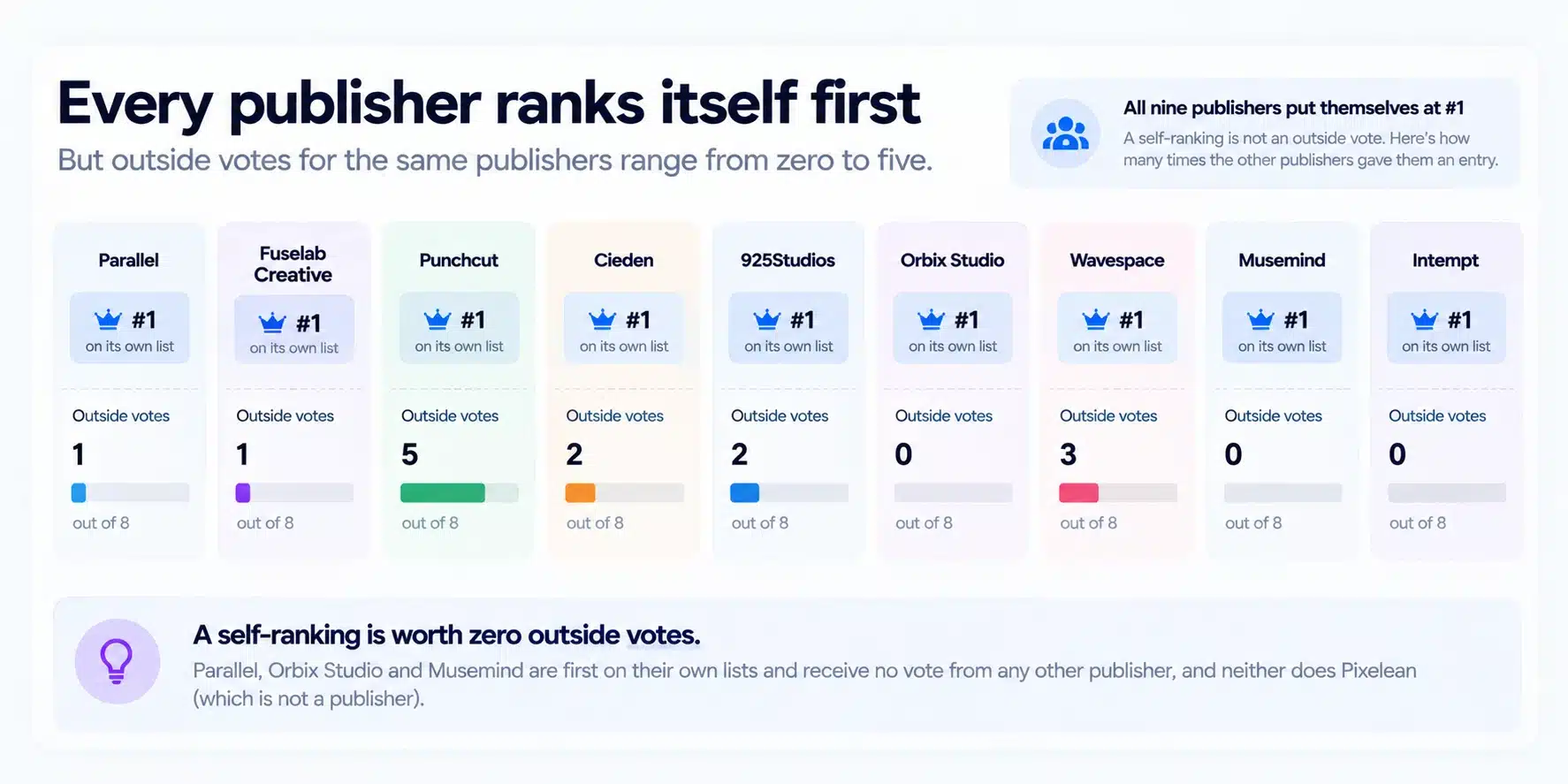
Three of the eight agency publishers clear the three-vote bar that this list applies to everyone else. Two receive a single vote, three receive none, and Pixelean makes four at zero.
Four of these publishers run more than one list on the topic, and each of the four is first on all of its own. Parallel has four lists and describes two of them as independent comparisons.
An agency without votes may do good work, since the count records who gets named and nothing more, but a first place that an agency awards itself tells a buyer nothing that the buyer could not have guessed before opening the page. Apply the same discount to our entry.


Not sure how your current website was built?
Send us the URL. We will tell you what is under it and what that means for your next redesign.
When you do not need an AI specialist
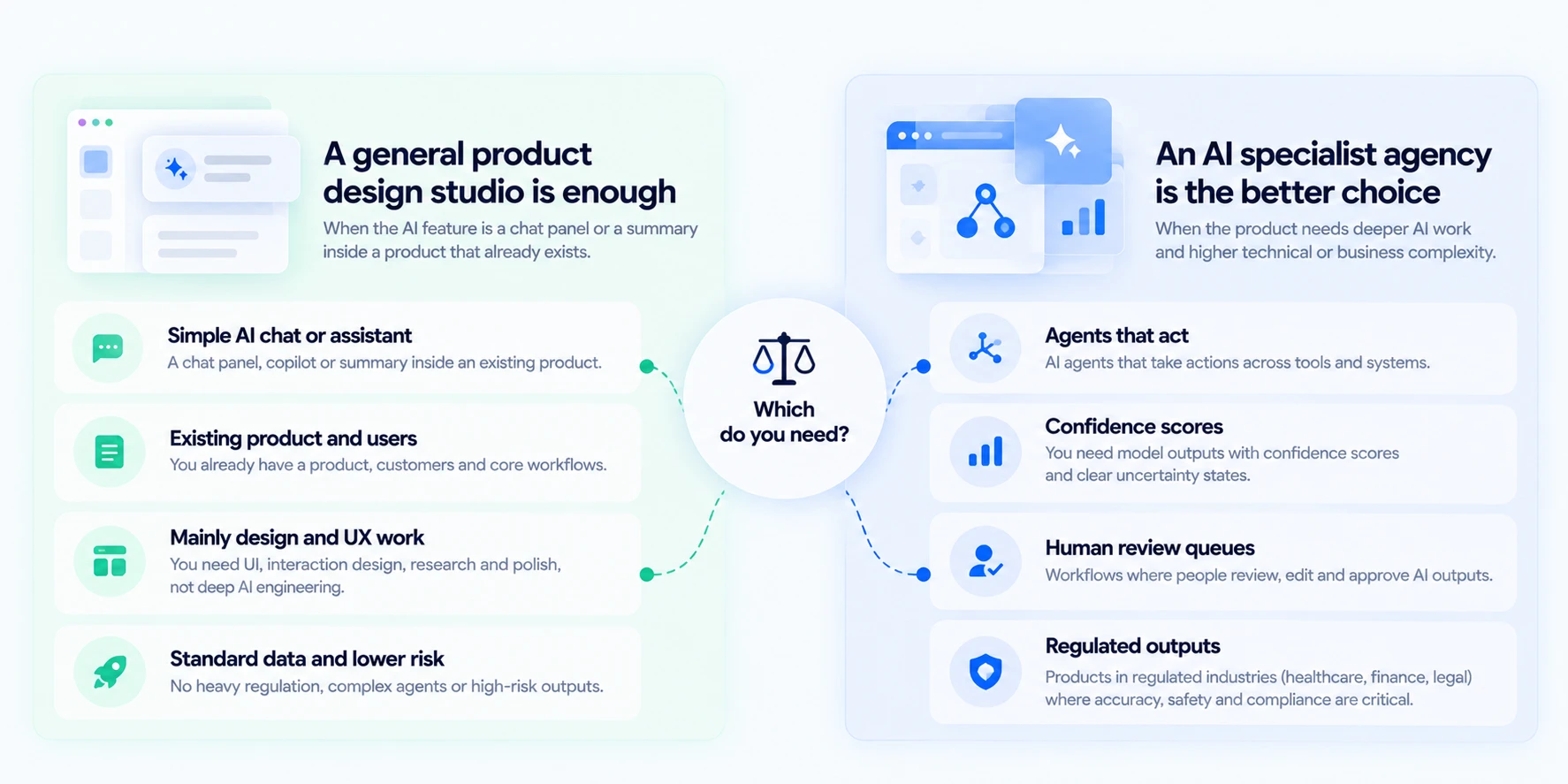
A general product studio is enough when nobody acts on the model’s output without checking it first.
A chat panel added to an existing SaaS product is ordinary product design with a few extra states, and so is a button that summarizes a long record. The designer has to draw the loading state, the empty answer, the wrong answer and a way to retry, which comes to three or four screens on top of the normal work. Paying a specialist rate for those screens is money spent on a label, and the best UX design agency for that job is the one that already knows your product and your users. That kind of work, an AI feature inside a product that already has users, is the work Pixelean takes on.
A specialist earns the fee when people act on what the model says, and four situations mark the line.
- Agents that act, where the system sends, books, pays or deletes without a person approving each step.
- Confidence scores, where a user must judge how far to trust a number the model produced.
- Human review queues, where staff approve or correct model output all day and the queue is the product.
- Regulated outputs, where a wrong answer has a legal or clinical cost.
In those cases the hard design work happens before any screen exists, because someone has to decide what the system may never do alone and when it must stop and ask a person. Pixelean is the wrong choice for that work, and the vote table above is a better place to start. Our guide on how to choose a UI/UX design agency covers the general case, and the SaaS design agency guide covers how to match an agency to your stage.
Four questions to ask before you sign
Each question has an answer you can check the same day.
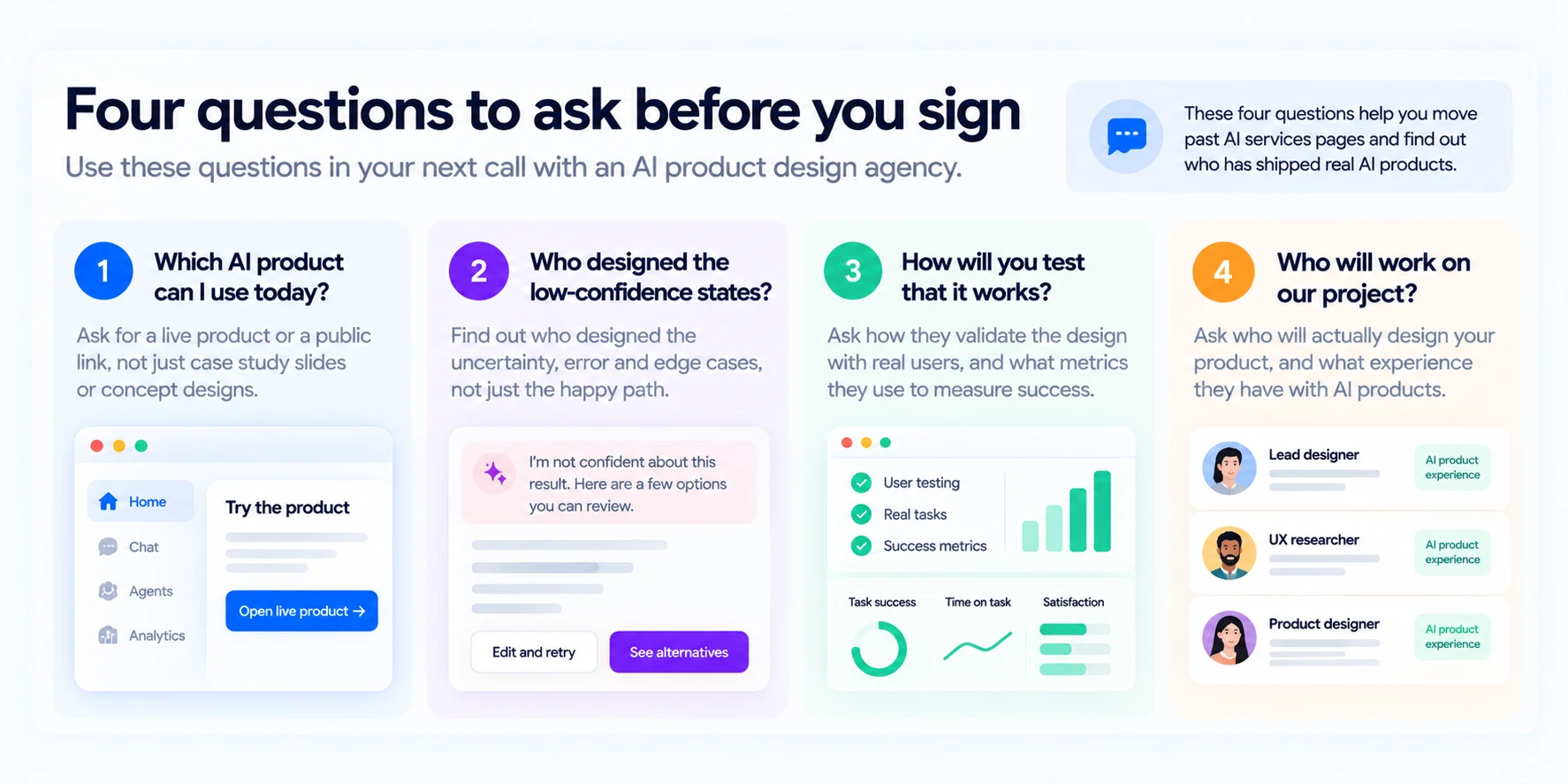
- Which shipped product can I use today? Ask for a link or an app store page, because a case study describes a project while a live product proves that the design survived engineering, launch and real users. Pixelean’s answer today is none, and you should weigh that against our price.
- Who designed the error and low-confidence states? A low-confidence state is the screen a user sees when the model is unsure of its answer. Ask to see those screens and to meet the person who drew them. An agency that has done the work will show them without being asked twice.
- Who on the team has worked with engineers on model behavior? Design for AI depends on what the model can and cannot do, and that knowledge sits with the engineers. Ask for a name, and for the project where that person worked beside the engineering team while the behavior was being tuned.
- What happens to the design when the model changes? Models are replaced, and the replacement behaves differently from the one the interface was drawn for. Ask what the agency hands over, in files and in written rules, so that your team can adjust the interface without signing a new contract.
An agency with real work answers the first question in one sentence. For how design teams use these tools in their own process, see AI for UI/UX design.
Frequently asked questions
How is designing for AI products different from standard UX?
Standard UX assumes that the same input gives the same result. A model can return a different answer to the same request, and some of those answers are wrong, so the design needs states that ordinary software lacks, such as low confidence, a wrong answer, a correction and an undo. Microsoft’s Guidelines for Human-AI Interaction set out 18 such practices, including a group for when the system is wrong.
What does an AI product design agency cost?
Of the 15 agencies here, three print a price on their own site. Pixelean charges $1,500 a week, or $2,990 or $4,990 a month. Cieden lists $50 to $99 an hour from a $10,000 starting budget. Fuselab Creative lists $100 to $149 an hour with a $25,000 minimum. The other 12 publish none. Our UI/UX design cost guide explains what moves the number.
Should I hire a specialist or a general product design agency?
Hire a specialist AI product design agency when people act on the model’s output, as with agents that take actions, confidence scores, review queues or regulated answers. A general product design agency is enough for a chat panel or a summary feature inside a product that already exists.
How do I check that an AI case study is real?
Ask for a product you can use today, by link or app store page, and then ask who designed the error states and request those screens. A real project produces both within a day, while a concept produces polished screens of the moments when everything works and nothing else.
How long does an AI product design project take?
No agency on this list publishes a fixed duration on the pages we read, so treat any quoted timeline as specific to your scope. Ask each agency for a dated plan against three counts, which are the screens, the user roles and the states where the model can be wrong or unsure.
The bottom line
The best UX design agencies for AI products are the ones other agencies name when they have nothing to gain from naming them. Start from the vote table and pick three agencies whose “best for” line matches your stage and whose price, where one is published, fits your budget. Put the four questions to each of the three and compare their answers to the first question. If your AI feature is a chat panel or a summary, skip the specialists and hire a studio that knows product design.
Book a 30-minute call with Pixelean, and we will tell you on that call if we are the wrong fit.
Sources
All pages read on 6 October 2026.
- Parallel, Best AI UX Design Agencies for AI Startups
- Parallel, Best AI UX Design Agencies for Seed Startups
- Parallel, Best Product Design Agencies for AI Startups
- Parallel, Best Product Design Agencies for AI Startups, second list
- Fuselab Creative, Best AI UX Design Agencies
- Punchcut, 11 Best UX Design Agencies for AI Products
- Cieden, 9 AI Design Agencies
- 925Studios, Best AI UX Design Agencies
- 925Studios, 11 AI Product Design Agencies That Work With LLMs Daily
- Orbix Studio, 10 Best AI Product Design Agencies
- Wavespace, Best 10 AI Product Design Agencies Worldwide
- Wavespace, Top 10 AI UI UX Design and Development Agencies
- Musemind, 9 Best AI Product Design Agencies
- Musemind, Top 11 AI-Based UI UX Design Agencies
- Intempt, Best UX Design Agencies for AI Products
Agency facts come from each agency’s own site, read on the same date. The FAQ also cites Microsoft’s Guidelines for Human-AI Interaction.