UI/UX design costs $3,000 to $150,000. Real product work lands tighter than that, usually $8,000 to $60,000, with the tails running lower and much higher. The range is true and it is close to useless to you, because your project has one specific number, and the rest of this page shows how that number gets built.
We price and ship interface design every week from Dhaka and Albuquerque, and we read a lot of other studios’ quotes on the way in. So this is written for the person holding two or three quotes right now who cannot work out why they disagree by a factor of ten. It is also for the person about to ask for those quotes who wants to sound like they already know the game.
There is no pep talk here about the value of good design. You are past that. You want the number, and you want to know which parts of it are real and which parts are a studio quietly protecting itself.
Key takeaways
- The market pays around $3,000 for a small landing site and up to $150,000 for a growth-stage SaaS platform, design only, development billed separately.
- Screen count is the wrong unit. States, decisions, and unfamiliar domain logic set the UI/UX design cost, not the number of artboards.
- The pricing model in a proposal tells you how the studio splits risk with you. Read the model before you read the number.
- Design usually runs 15 to 25 percent of a full build budget. A cheap design bought with no development reality behind it becomes the most expensive line in the project.
The short answer, by project type
Here is what the market charges for UI/UX design, sorted by the kind of project. These are design-only numbers. Development is a separate budget, and confusing the two is the most common budgeting mistake buyers make.
| Project type | Typical range | What moves the number |
| Landing page or marketing site (5-8 pages) | $3,000-$12,000 | Custom illustration, copy support, animation |
| Full marketing website (10-25 pages) | $10,000-$35,000 | Page count, CMS build, content design |
| MVP product design (10-20 screens) | $8,000-$25,000 | Number of real states, not screens |
| SaaS dashboard, early stage | $15,000-$50,000 | Data density, roles, permission variants |
| SaaS platform, growth stage | $60,000-$150,000 | Existing debt, stakeholder count |
| Mobile app, full product | $20,000-$80,000 | Platform parity, native patterns |
| Design system, standalone | $10,000-$40,000 | Component count, documentation depth |
| UX audit only, scoped to one flow | $2,000-$8,000 | Research depth, size of the flow |
These are the numbers we see coming across our desk every week, and they line up with the published rate guides. One caution on the last row. A $2,000 to $8,000 UX audit covers one scoped flow. A full multi-flow product audit runs $8,000 to $25,000 and higher for compliance-heavy work. Keep reading to the design versus development section, because the number above is only half of your real spend.
Why screen count is the wrong thing to count
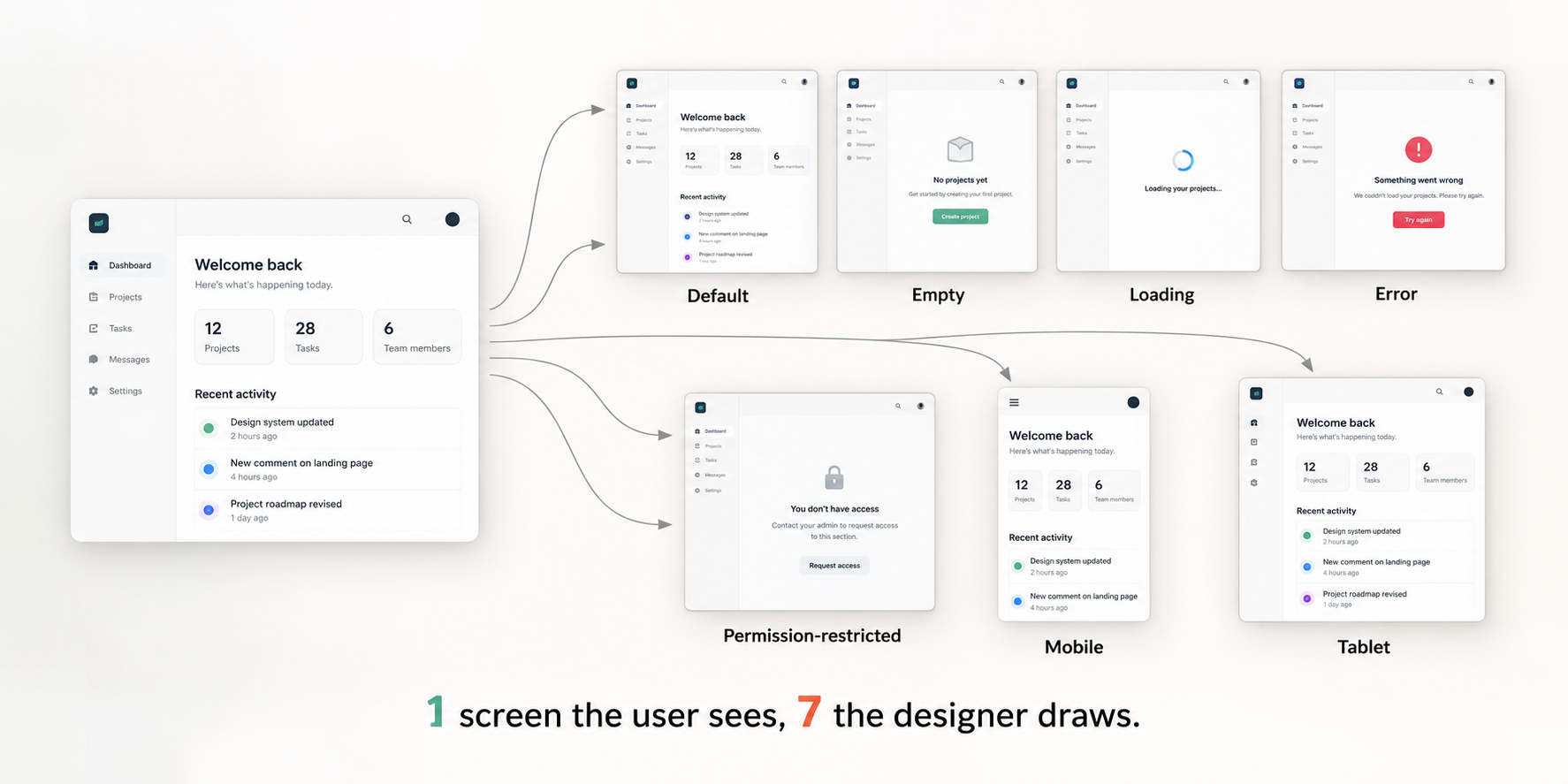
A screen is not a unit of work. A state is. This is the single idea that separates a quote you can trust from a quote that will grow a change order later.
Ask a studio how many screens your app has and you will get a small number. Ask how many artboards the design actually needs and the honest answer triples. In our experience a 20-screen app is really 55 to 70 artboards once you add empty states, error states, loading states, permission variants, and mobile breakpoints. The user sees 20 screens. The designer draws all 70, and every one of them is a real decision about what the product does when something goes wrong.
The second driver is decisions, not pixels. A screen with one obvious layout takes hours. A screen where three teams disagree about what matters most takes weeks, and no amount of design skill shortens that argument. You are paying for the resolution of a disagreement, and that clock runs at your speed, not the designer’s.
The third driver is unfamiliar domain logic. Designing a booking flow is fast because the patterns are known. Designing a claims adjudication flow is slow, because the designer has to learn your business before drawing a single frame. The learning is the work, and the learning is billable.
So when a studio quotes you strictly by screen count, one of two things is happening. They are padding the per-screen price for the states they know are coming, or they will come back mid-project with a change order once the states arrive. Neither is dishonest. Both cost you money you did not plan for, which is why a UI/UX design cost per screen figure tells you almost nothing on its own.
The four pricing models, and what each one tells you about the studio
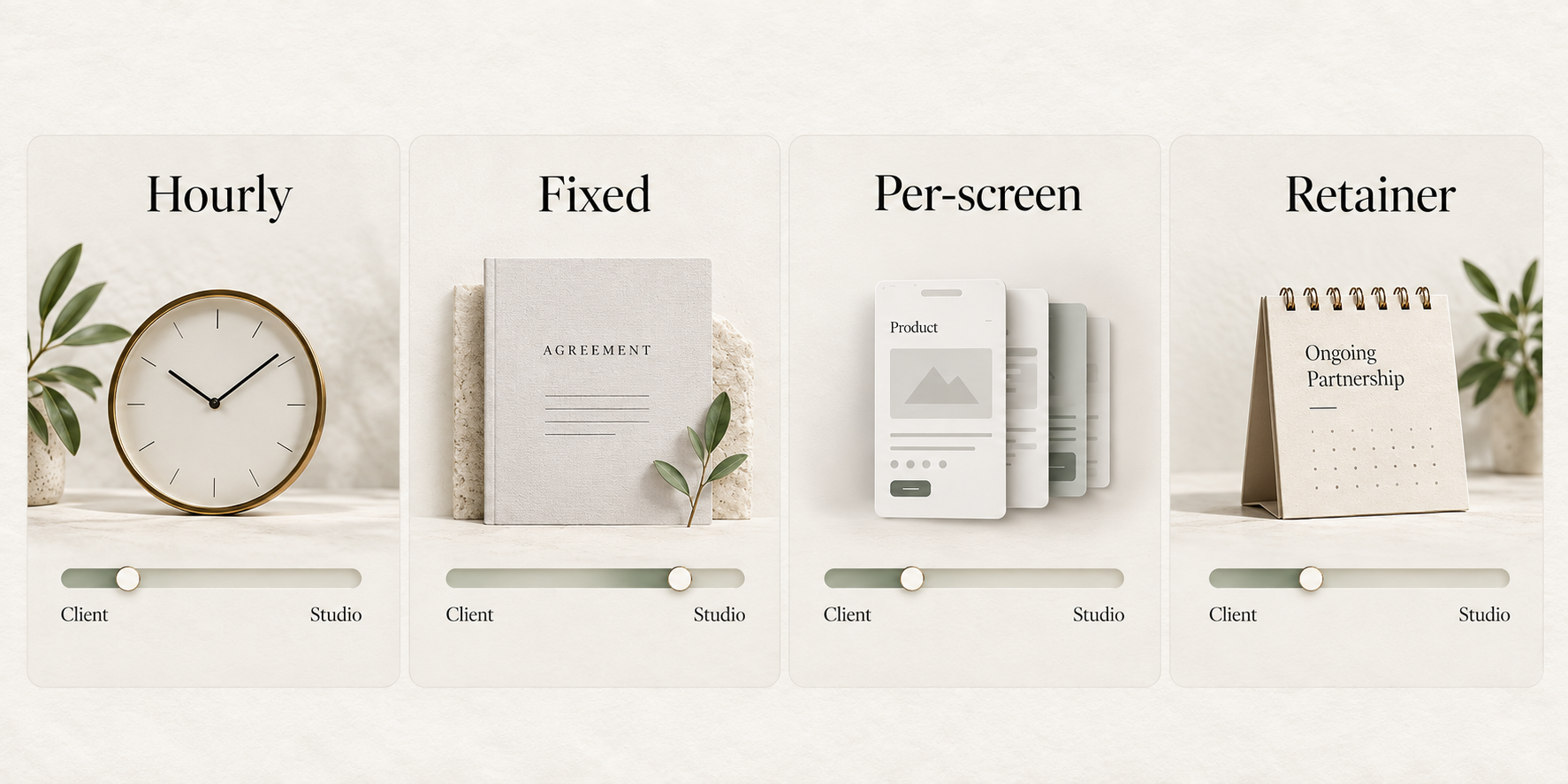
The pricing model in your proposal is a signal. It tells you how the studio has decided to split risk with you, before you have read a single number. There are four, and each one carries the risk somewhere different.
Hourly
In the quotes we see, hourly runs $75 to $195 for an established designer, set by seniority and location, with the median near $120. It works when scope is genuinely unknown, such as an ongoing product with shifting priorities. The risk is that there is no ceiling, and you carry all of the estimation risk yourself.
Fixed project price
A fixed bid is the most common model for a defined scope. The studio prices a risk buffer into the number, and you pay for that buffer even when the risk it covers never shows up. The risk here is quieter. Anything outside the written scope becomes a negotiation in the middle of the project, when you have the least room to push back.
Per page or per screen
Per-screen pricing is fine for a marketing site, where a page really is a unit of work. It breaks down for products, for every reason in the section above. Be blunt with yourself about this one. If a product studio quotes you per page, they are pricing a website and calling it a product, and the states will arrive as extras.
Monthly retainer or dedicated designer
A full-service design retainer runs $10,000 to $30,000 and up a month, scaling with the number of designers and the hours you reserve. A single dedicated designer or a productized subscription runs well below that, which is the model in our own pricing further down. A retainer is the right model when design is continuous rather than a one-time build. The risk is specific. A retainer pays for availability, not output, so it only earns its keep when you have a real backlog to feed it.
The model in your proposal is the studio telling you how confident it is about your scope. Read it that way. For a deeper walk through reading a full proposal, our guide on what to expect from web design agency pricing takes it line by line.
What each project type actually involves
The table gave you ranges. Here is what the money actually buys inside each type, and the one thing that reliably pushes the number up.
Marketing website design
A marketing site buys layout, content design, and a small component set, usually on a CMS the client can update. What pushes it up is custom work that cannot be templated, such as bespoke illustration, motion, or a design that has to survive heavy copy changes without breaking. A clean five-page site sits near the bottom of the range. A twenty-page site with a content model and editorial design sits near the top.
MVP and early product design
An MVP design buys the core flows a first user needs to reach value, drawn well enough to build and test. The thing that pushes it up is the number of real states hiding behind those flows, not the screen count in the pitch deck. Spend here on the flows that prove the product, and defer the rest. For the build side of an early product, our MVP development company guide covers what pairs with this design spend.
SaaS dashboards and internal tools
A SaaS dashboard buys information design, which is the hard and expensive kind. You are paying for data density, user roles, permission variants, and empty and error states that outnumber the happy paths. What pushes it up is existing product debt, since redrawing around ten inconsistent old patterns costs more than drawing ten new ones. See our SaaS application design work for how this scopes.
Mobile app design
A full mobile app design buys platform-correct patterns and parity across the states, which is more work than a web equivalent of the same screen count. This is a large topic with its own math, so we keep it short here and point you to the dedicated mobile app design cost breakdown and our mobile app design service.
Design systems
A design system buys reusable components, the rules that govern them, and the documentation that lets a team use them without asking the designer. What pushes it up is component count and how deep the documentation goes. A system built once and used across five products is cheap per use. A system built and never adopted is pure cost.
UX audits and redesigns
An audit buys a diagnosis, not a redraw. A scoped audit of one flow is inexpensive and fast. A redesign is a different project with its own number, and the honest ones start from the audit rather than the aesthetics. Our website redesign cost piece separates the two so you do not pay redesign prices for an audit problem. A scoped landing project fits our landing page design service.



Not sure what your UI/UX design should cost?
Send us what you have. We will send back a scoped range and the reasoning behind every number, so you can read your other quotes with the same math.
Freelancer, agency, in-house, or marketplace
There is no single right answer here, only a right answer for your specific situation. The four options carry different costs and fail in different ways.
| Option | Typical cost | Works when | Breaks when |
| Freelancer | $50-$150 per hour | One defined deliverable, a founder who can art direct | Scope spans research, UI, and handoff at once |
| Agency or studio | $100-$250 per hour equivalent | Multi-discipline product work with real stakes | Budget is tiny and scope is one screen |
| In-house hire | $90,000-$180,000 per year loaded | Design is continuous and central to the product | You need output this quarter, not this year |
| Marketplace platform | $25-$80 per hour | Commodity, well-specified visual work | The work needs judgment, not just hands |
Here is the part a studio usually will not write for you. A freelancer is the correct choice more often than agencies admit. A single landing page, a defined redesign, a founder who can art direct and make decisions fast, all of these are freelancer jobs, and naming that plainly builds more trust than any badge on a homepage.
Then there is the cost nobody puts in the quote, which is coordination. Three freelancers at $60 an hour looks cheaper on paper than one agency at $150 an hour, right up until someone has to keep the research, the UI, and the developer handoff consistent across all three. That someone is usually the founder, and founder hours are the most expensive hours in the company. When you compare UI/UX design cost across these options, price the coordination in, because it is real and it is yours. Our guide on how to choose a UI/UX design agency for your product covers what to look for once you have decided direction matters more than raw rate.
The geography question, answered honestly
The rate spread across regions is real, and pretending it is not helps no one. US agency work runs $100 to $200 and up an hour and UK work $75 to $150, while strong teams in Eastern Europe and South Asia run $25 to $99, with Poland near the top of that band and India and the Philippines at $25 to $49. For the same skill, hiring well, a strong South Asian team can cost a third of a US rate.
Here is what actually changes and what does not. Design skill is not regional. Cost of living is. Anyone telling you offshore work is inherently lower quality is defending their own rate card, and you should read it as exactly that. The portfolios settle the argument faster than the map does, and outcome-based case studies, not location, are what separate a $60 designer from a $175 one.
Now the honest other side, because this is what earns your trust. What genuinely goes wrong with distant teams is not the quality of the work. It is communication overhead, timezone lag on decisions, and teams that take a brief literally instead of pushing back on it. That failure mode is documented. In Nielsen Norman Group’s 2021 study of remote design work, run when most of the 306 practitioners surveyed had just gone remote for the first time, communication was the biggest challenge, named by 43 percent, ahead of every other problem (Nielsen Norman Group, Remote Design Work: Top Challenges).
So do not use a rule. Use a test. Ask any team, in any location, three questions before you sign.
- Who exactly will be on my project, and can I meet them before I sign.
- What happens when you disagree with my brief.
- What is your response window, in hours, in my timezone.
The answers tell you more than the rate does. We run from Dhaka and Albuquerque, so we sit on both sides of this question and answer those three the same way to everyone who asks.
Design budget versus development budget
This is the section that prevents the most expensive mistake in the whole process. Design is typically 15 to 25 percent of a full build budget, higher for design-led products. If a studio quoted you design at $40,000, the build behind it is usually another $120,000 to $225,000.
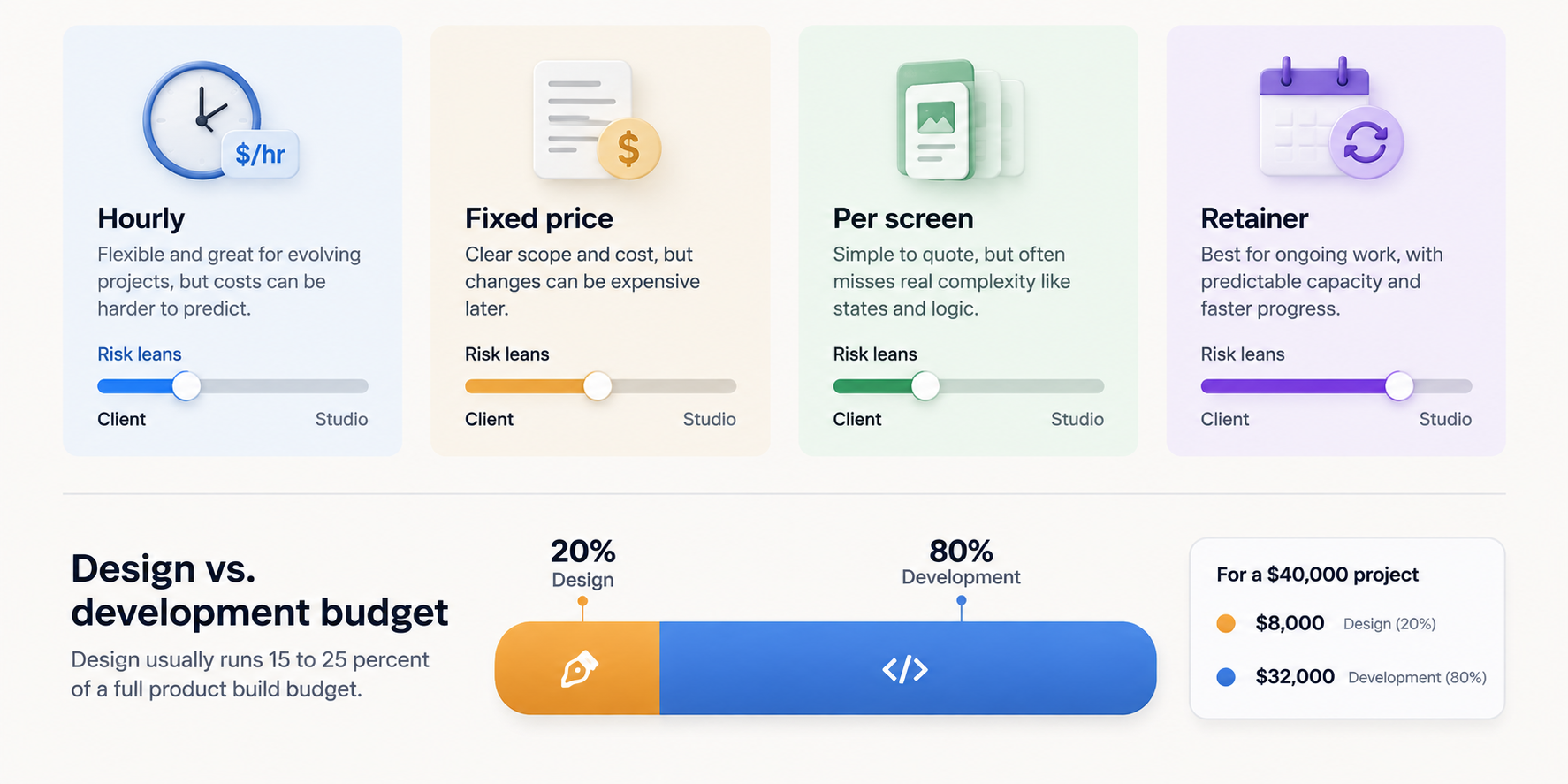
The trap is design priced with no development reality behind it. A beautiful Figma file that triples the build cost is a real and common outcome, and the design looked like a bargain right up until an engineer opened it. You did not save money. You moved the cost downstream and added interest.
What changes when design and development sit with the same team is structural. There are fewer developer handoff losses, and the designer knows what is expensive to build before drawing it. That is not a claim that one team is better than two. It is a claim about where the losses go, and with a split you carry the translation cost yourself. Our web development work is built to remove that particular tax.
What a real design quote includes
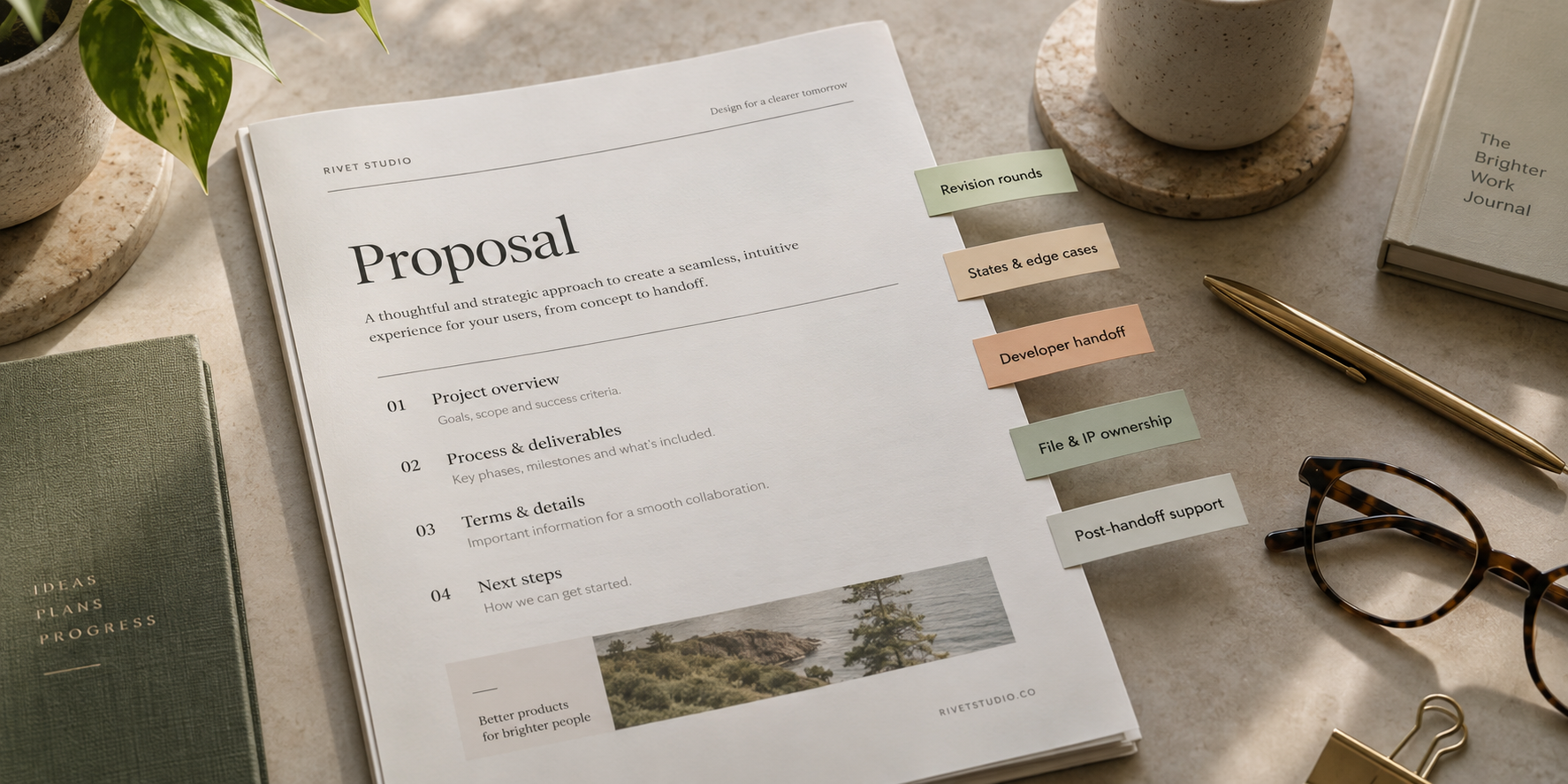
A quote is only as good as what it writes down. Here are the five clauses that should be explicit, and what each one costs you when it is missing.
- Revision rounds, by phase, with a number attached. Without a number, “unlimited” means unlimited arguments, and the project drifts until someone blinks.
- States and edge cases, named in or out. Left unnamed, every empty state and error state becomes a change order at the studio’s convenience.
- Developer handoff format, and whether developer support is included. Skip this and you pay twice, once for the design and again for the week your engineer spends decoding it.
- File and IP ownership after final payment. If Figma file ownership is not written down, you can pay in full and still not control your own product design.
- What happens after handoff, and for how long. With no answer, week-two questions land in a paid support conversation you did not budget for.
Read a quote for these five before you read the price. A low number missing three of them is not a low number.
Where design budgets get wasted
Waste in a design project is rarely the hourly rate. It is the pattern of spend, and the patterns repeat.
- Research that never reaches a design decision. Insight is only worth what it changes.
- Designing every screen before validating the core flow. You polished forty screens around an idea that did not survive contact with one user.
- Rework from late stakeholder entry. The executive who appears at the final review is the single largest source of overrun in the projects we see.
- Paying twice. Design bought with no development input, then redrawn once an engineer flags what cannot be built.
- Pixel polish on flows users abandon in week two.
None of these show up as a line on the quote. All of them show up on the invoice.
How to spend less without buying worse work
The standard advice for cutting UI/UX design cost is wrong. “Use templates” and “outsource the research” are recommendations that make the work worse and cost you more later. Here is what actually reduces the number without buying worse work.
- Cut scope, not quality. Fewer flows, each one designed properly, beats every flow designed halfway.
- Bring the decision maker to every review. Late feedback is the most expensive thing in a design project, and it is free to prevent.
- Give the studio your real constraints on day one, including the budget number. Withholding the number does not get you a lower price. It gets you a proposal for the wrong project.
- Reuse a component library where one already exists, instead of paying to redraw solved problems.
- Phase the work. Core flows now, secondary screens after the product has users and you know which screens matter.
Every item on that list lowers the price by removing waste, not by removing skill. That is the only kind of saving that survives to launch.
What underpaying actually costs
The math on cheap design is simple and it is brutal. A $4,000 design that has to be redone does not cost $4,000. It costs $4,000, plus the new $18,000 to do it right, plus four months of market time you will never get back.
The real cost is rarely the money. It is shipping late with a product that does not convert, and discovering both at once. The cheapest design in the room is often the one you pay for twice.
What Pixelean charges
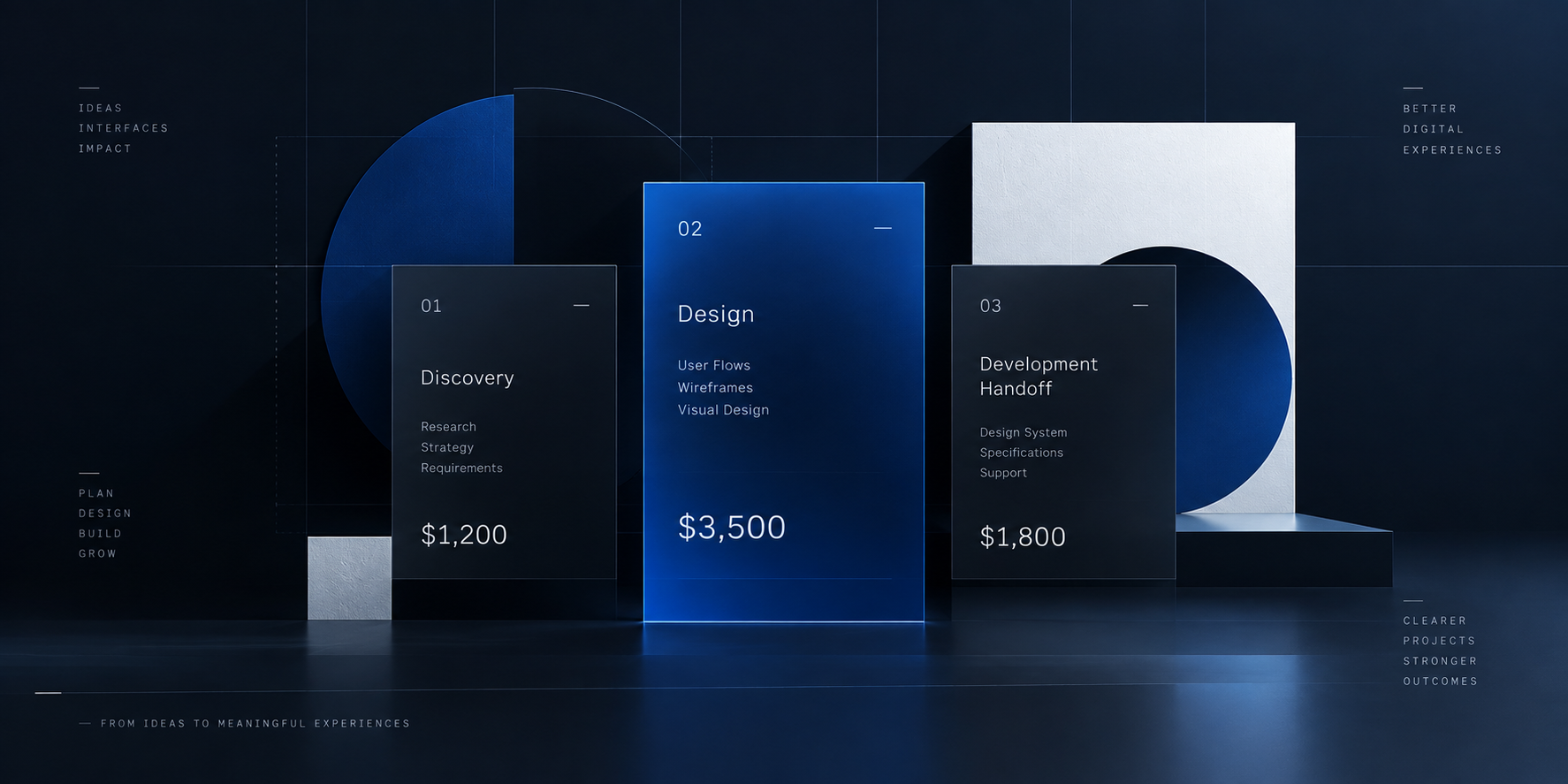
We do not bid per project, and everything above is why. A fixed bid charges you a risk buffer and then penalizes the scope changes every real product needs, and a per-screen quote hides the state complexity that drives the real cost. So we price UI/UX design as a weekly or monthly subscription, because product design is continuous work.
- Weekly Design Plan at $1,500 a week. One dedicated designer and a project manager, 30 hours a week, one active task. This is the flexible option, billed week to week, so it runs a little higher per hour in exchange for the freedom to stop any week.
- Startup at $2,990 a month. One dedicated designer and a project manager, 15 hours a week, one active task.
- Enterprise at $4,990 a month. Two designers and a project manager sharing 30 hours a week across the team, up to two active tasks running in parallel.
- Custom, quoted, when you need developers or a no-code build attached to the design.
Every plan runs on designer hours rather than a fixed list of deliverables, so revisions are not counted. Each also includes a 12-hour turnaround, the ability to adjust hours as your backlog moves, and pause or cancel whenever the work slows.
Run the math on those plans and the effective rate lands near $40 to $50 an hour. That is the South Asian band from the geography section, and it is deliberate, not a discount. The gap between it and a US agency’s $150 is cost of living, not skill. We argued above that a lower rate does not mean lower work, and we are not going to pretend the rule stops at our own door.
We are the wrong choice for one job. If you have a single screen to fix and no pipeline of design work behind it, a subscription is the most expensive way to buy that one screen, and a fixed-scope freelancer is the right call. When there is a real backlog, the plans above beat hourly on both price and speed. The full detail sits on our pricing page, and the service itself is our UI/UX design practice.
Frequently asked questions
How much does UI/UX design cost per screen?
There is no reliable per-screen price, because a screen is not a unit of work. A single screen can carry five hidden states, and two screens of equal appearance can differ tenfold in effort. Studios that quote per screen are estimating states they have not named yet.
How much does a UX designer charge per hour?
UX design rates run $75 to $195 an hour for established designers, with the market median near $120. Junior and marketplace designers start lower, near $30, and seniors reach $175. Outcome-based portfolios, not years of experience alone, set the top of the range.
Is UI/UX design worth the cost for an MVP?
For an MVP, yes, if you scope it to the core flow. Design the two or three flows that prove the product works, build and test those, and defer the rest. The waste is designing every screen before one user has validated the idea, not the design itself.
What is included in a UI/UX design package?
A real package includes discovery, user flows, wireframes, UI design, a developer handoff, and named revision rounds. The clauses that decide your true cost are edge-case coverage, Figma file ownership, and post-handoff support. Read those three before the price.
How much does UI/UX design cost for a SaaS product?
Early-stage SaaS dashboard design runs $15,000 to $50,000, and growth-stage platforms reach $60,000 to $150,000, design only. Data density, user roles, and permission variants drive the number far more than the visible screen count does.
Do I own the Figma files after paying?
You should, but only if the quote says so. File and IP ownership after final payment is a clause, not a default. If it is not written down, you can pay in full and still not control your own product design, so confirm it before you sign.
How long does a UI/UX design project take?
A scoped MVP design runs three to six weeks, an early SaaS dashboard six to ten, and a growth-stage platform longer. Decision speed sets the clock more than design speed does. A team that meets to approve fast finishes fast.
The bottom line
There is no single price for UI/UX design, and any number quoted without seeing your states, your decisions, and your domain is a guess dressed as a quote. The market runs from $3,000 to $150,000, but your project has one real number, built from the work behind the screens, not the screens themselves. Read the pricing model to see who carries the risk. Read the quote’s clauses before you read its total. And remember the cost that never lands on the invoice, a cheap design redrawn after an engineer opens it. The right number is the one a studio can defend to you line by line. If yours cannot, that is your answer.
Send us the scope
Send what you have. A rough feature list, a competitor you like, or three screenshots is enough. You get back a range and the reasoning behind it, so you can read your other quotes with the same math we just walked through.
Sources
- Nielsen Norman Group, Remote Design Work: Top Challenges (2021)