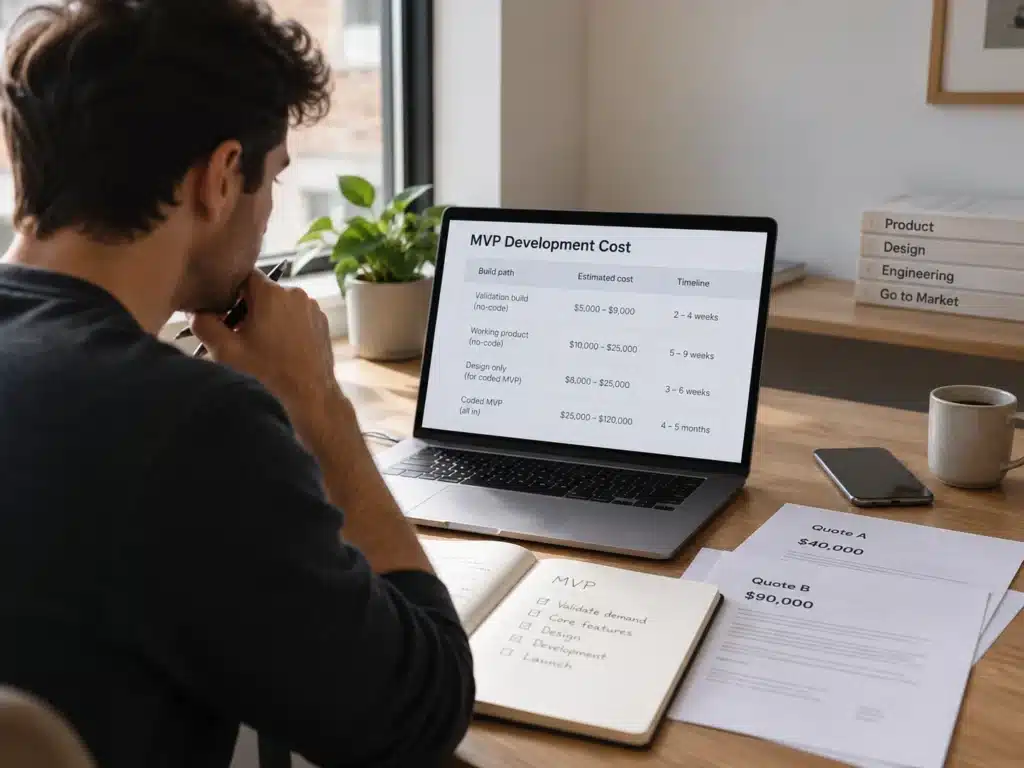
Two founders land on this page.
The first has a number in their head. It usually came from a friend who built something four years ago, on a different stack, for a different market. That number is almost always wrong, and it can be wrong in either direction.
The second has a quote in their inbox. Forty thousand dollars, maybe ninety. They have no way to tell if it is fair, because the people publishing MVP development cost figures are the same agencies sending the quotes.
This page is for both of them. You will see what each build path costs, what actually moves the number, what the design portion buys you, and what the cheap version costs you in month four. If you are still deciding who should build it, start with our guide to choosing an MVP development company.
One disclosure up front. We build the cheap path and we design the expensive one, so we have no reason to push you up the table.
Key takeaways
- The build path decides your MVP development cost more than the feature list does.
- A no-code MVP and a coded MVP are two different products for two different stages.
- Design is rarely the expensive part. Indecision is.
- Overruns usually come from scope changes. Bad estimates are the smaller problem.
- Price the exit before you pick the path.
The four numbers, before anything else
Start with the answer. Your MVP development cost depends first on the path you pick, and there are only four.
| What you are buying | Cost | Time |
| Validation build, no-code | $5,000 to $9,000 | 2 to 4 weeks |
| Working product, no-code | $10,000 to $25,000 | 5 to 9 weeks |
| Design only, for a coded MVP | $8,000 to $25,000 | 3 to 6 weeks |
| Coded MVP, all in | $25,000 to $120,000 | 4 to 5 months |
The bottom of each range is one type of user, one core flow, and a founder who answers questions the same day. The top is several user types, payments or third-party integrations, and a scope that keeps moving.
Three of these four rows are the same idea at different levels of ambition. The fourth is a different commitment. The pattern we see is founders picking the fourth row before they have a reason to.
These numbers also agree with each other, and you can check the math yourself. Design runs 15 to 25 percent of a full build budget. $8,000 divided by 25 percent is $32,000. $25,000 divided by 25 percent is $100,000. Both sit inside row four. Run the top of the design range at 15 percent and you get about $167,000, which is past row four entirely. That is the signal. A $25,000 design only fits an MVP when design is a bigger share of the build than usual.
Ask any agency quoting your MVP development cost to show the same arithmetic. Some cost pages open with a range from $5,000 to $500,000. A number that wide only helps once someone shows you the math inside it.
No-code or code, and what each one costs
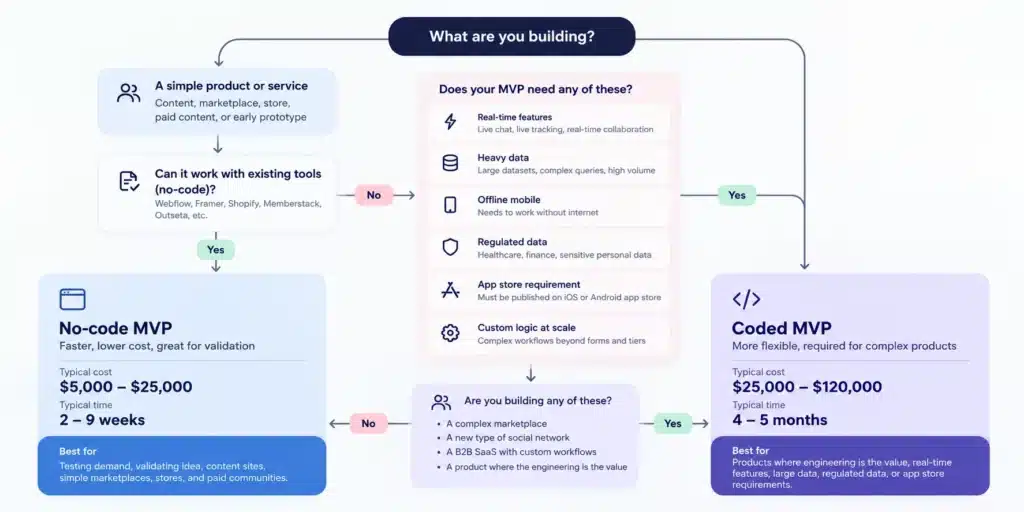
This is the decision that matters. Pick the path first and most of the cost to build an MVP follows from it.
| Path | Where it sits | Good for | Breaks when |
| Landing page and waitlist (Framer, Webflow) | Row one, $5,000 to $9,000 | Testing demand, price, and message | Users need to log in and use something |
| Content or directory site (Webflow CMS, WordPress) | Row two, $10,000 to $25,000 | Listings, guides, marketplaces with manual matching | Users need to transact with each other in real time |
| Store (Shopify) | Row two, $10,000 to $25,000 | Physical products, digital products, subscriptions | The software itself is what you sell |
| Gated product (Webflow or Framer plus Memberstack, Outseta, Stripe) | Row two, $10,000 to $25,000 | Paid content, communities, simple member tools | Your logic outgrows forms and member tiers |
| Coded build (your developers write it) | Row four, $25,000 to $120,000 | Products where the engineering is the value | You build it before anyone has asked for it |
App-platform tools like Bubble sit between these rows. We do not build on them, so we leave their pricing to the people who do.
What a landing page can actually answer. A landing page answers three questions. Does anyone want this? What will they pay? Which message makes them act? Three weeks and $6,000 answers all three. A $60,000 coded build answers the same three, four months later. Founders skip this step because it feels too small to count as real work.
That is an expensive instinct. Of the 385 venture-backed shutdowns where CB Insights could identify a cause, 43 percent cited poor product-market fit. A landing page is the cheapest way to find out early.
Where no-code stops. Webflow and Framer MVPs hit a wall at six things. Real-time features, heavy data, offline mobile, regulated data, an app that has to live in an app store, or a product whose entire value is the engineering. If your idea is on that list, the cheap path is closed to you. No agency should pretend otherwise.
The part nobody prices. Leaving no-code costs as much as a coded MVP. In our experience, a no-code product that works gets rebuilt in code within 12 to 18 months, and that rebuild is a full row four. You get no discount for having built it once. A no-code MVP is a bill you chose to defer. Deferring it is usually still right, because you pay it with revenue and users instead of a pitch deck.
When skipping straight to code is correct. Go straight to code in four cases. You are funded. You have already validated demand. The engineering is the product. Or a regulator is involved. If any of those is true, the cheap path wastes your time, and we will tell you so.
What actually moves the number
Five things move MVP costs, and they are far from equal. Cost guides tend to list ten or twelve factors in no particular order. The order is the useful part, because it tells you where the cost to develop an MVP actually goes.
1. The number of user roles
Each user role is its own product. One role means one set of screens, one set of permissions, one onboarding. Add a seller or an admin and every flow now has two versions and a rulebook between them. Three roles is three products sharing one login. Our guide to SaaS UX design best practices shows how roles multiply screens.
2. Anything that talks to anything else
Every integration adds a build and a new way to fail. Payments, login, a CRM, a third-party API. Each one needs setup, error states, and testing against a system you do not control. Off-the-shelf tools like Stripe keep this cheap. Custom connections get expensive fast.
3. Regulated data
Regulated data adds a review you cannot skip. Health records, financial data, anything with a compliance review attached. The build slows down, the paperwork grows, and no-code usually drops off the table.
4. Mobile, and whether it truly has to be native
Native mobile is where MVP app cost jumps. A native app brings app store review, device testing, and often two platforms to maintain, so MVP app development cost lands near the top of row four. Ask if a mobile web version would answer the same question first. Our mobile app design cost guide covers the design side.
5. How settled the idea is
An undecided founder is the most expensive line item on any invoice. It never appears on the estimate. Every decision that changes after design starts gets paid for twice, once to draw it and once to redraw it.
Where the design money goes
Design for an MVP costs $8,000 to $25,000 and takes three to six weeks for 10 to 20 screens. Development shops often show it as one line with no breakdown, which leaves you guessing what you are buying.
Open it up and design money buys five things.
- Discovery. Who uses it, what they need first, and what gets cut.
- The flows. The path a user takes from sign-up to the moment the product pays off.
- The screen count. Usually 10 to 20 screens for an MVP.
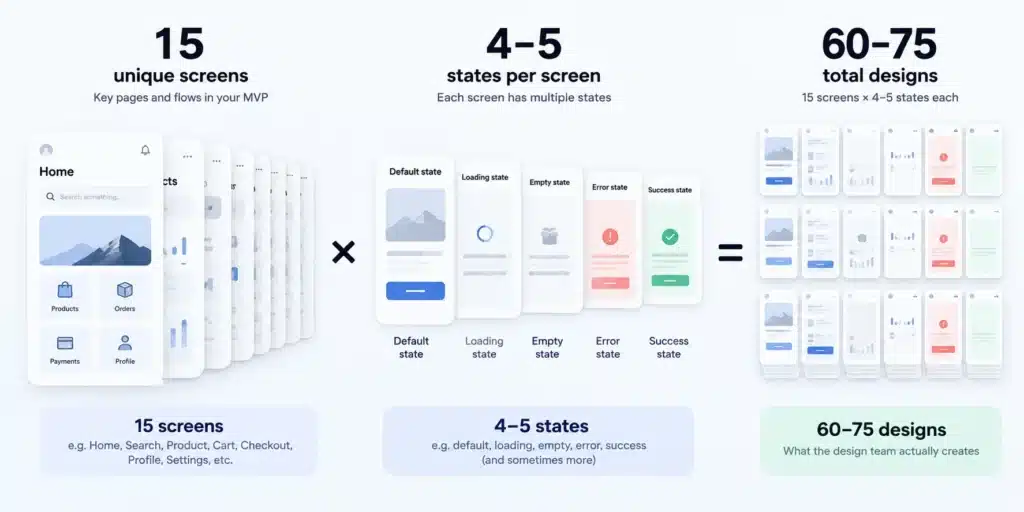
- The states. Empty, loading, error, success, no access. Every screen has several.
- The handoff file. Specs, components, and notes a developer can build from without guessing.
The states are where estimates go wrong. A 15-screen MVP with four or five states per screen is really 60 to 75 designs. We count states the way we count screens, and that count is what moves the design number.
Cheap design gets paid for later. A developer handed an unclear file makes the decisions themselves. Some of those decisions will be wrong, and you pay developer rates to rebuild them. Our full UI/UX design cost breakdown has the ranges for every project type.
Reading a quote, and why two $30,000 quotes are not the same
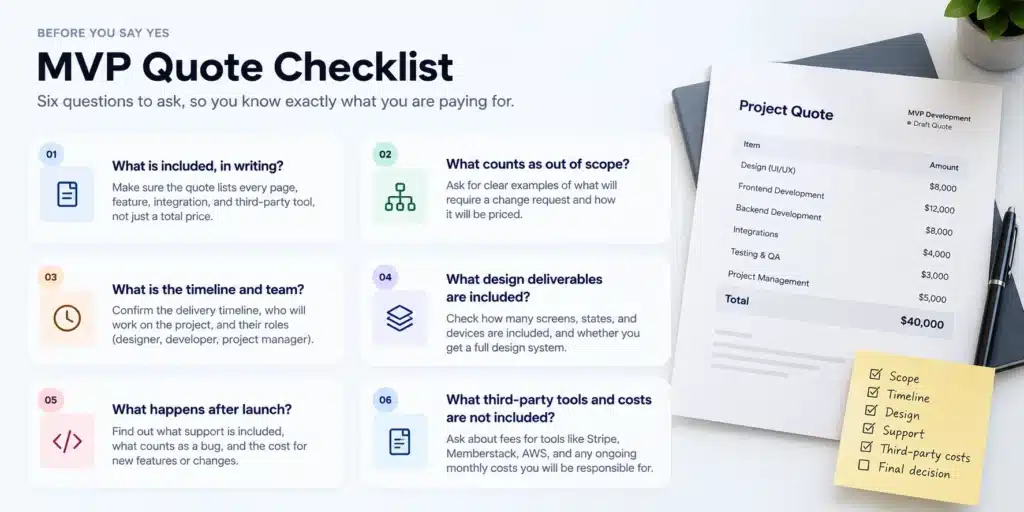
Is a $30,000 MVP quote fair? The total will not tell you. Two quotes at $30,000 can buy very different products, and the difference hides in six lines.
Is design in it? Ask if design sits inside the number or gets bolted on later. A quote without design pays a developer to build guesses.
Is QA in it? Testing is either in the price or on your weekend.
Who owns the code? You should own the source code, the accounts, and the domain from day one. Get it in writing.
How many revisions? A revision cap is normal. Know the number before round two, because round three is where budgets break.
Is post-launch support included? The first six weeks after launch produce fixes. Find out if those fixes are in the number or on a new invoice.
Fixed price, hourly, or subscription? Each model puts the risk somewhere. A fixed-price quote prices the agency’s risk, and you pay for it. Hourly prices yours. A subscription prices time, and you decide each week what that time goes to.
None of these is a trick. Just know which one you bought.
The costs that show up after launch
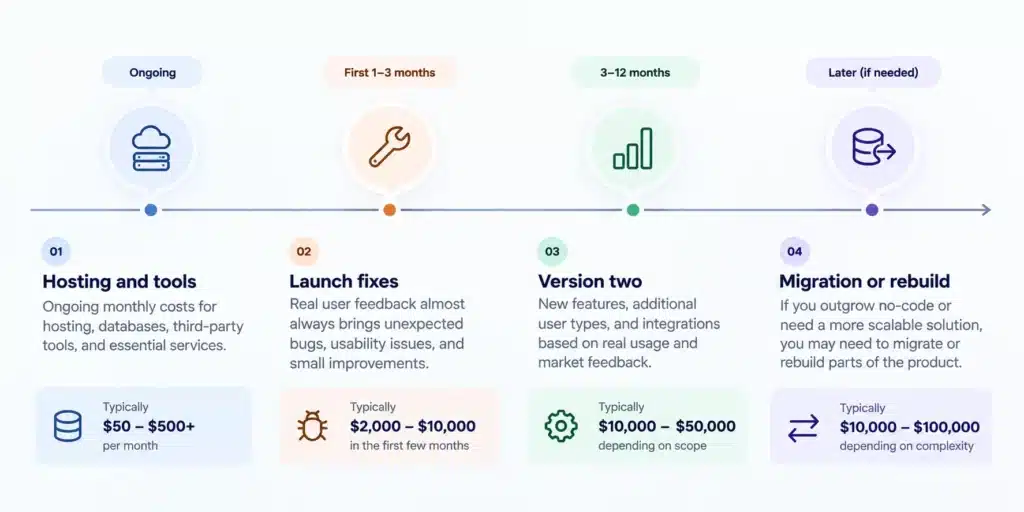
Launch day is where the spending starts. Four costs arrive in the first year.
- Hosting and tool subscriptions. Every stack carries monthly fees, and they grow with your users.
- The fixes in the first six weeks. Real users find what testing missed. These fixes are not optional.
- The second version. The MVP’s whole job is to tell you what to build next. Next costs money.
- The migration. If you went no-code and it worked, the rebuild from row four is coming.
Put your MVP development cost against real funding. Carta reports that few pre-seed deals exceed $2.5 million. Its data also shows that 35 percent of pre-seed rounds came in under $250,000 in Q4 2025. For those rounds, a $120,000 coded MVP is about half the raise or more.
So do not spend everything on the build. The MVP is the start of the spend.
How to spend less without wrecking it
Every cost guide says cut features. The useful part is knowing what each cut costs you.
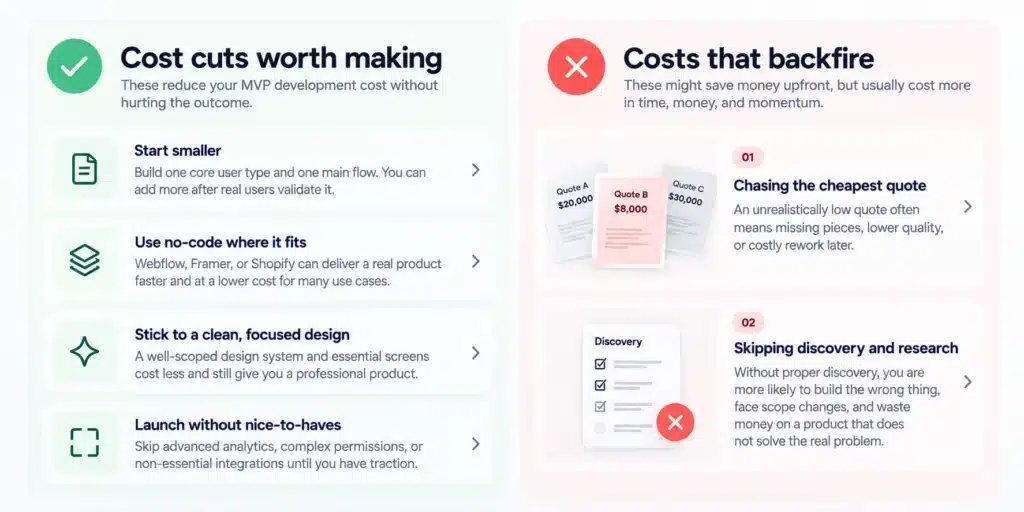
Four cuts worth making
Launch with one user role. One role at launch is the biggest single saving on this page. The trade is that your second user type waits, and some early customers wait with it.
Do it by hand until it hurts. Manual work beats expensive automation at MVP scale. Match users in a spreadsheet, send invoices yourself, approve accounts by email. This is a strategy with a clear exit. The trade is your own time.
Buy auth, payments, and email off the shelf. Stripe, a hosted login service, and a transactional email tool take days to set up instead of weeks to build. The trade is a monthly or per-transaction fee and less control.
Put a no-code front end on a real backend. A Webflow or Framer front end on a proper backend gives you speed now and a smaller rebuild later. The trade is two systems to maintain.
Two cuts that cost more than they save
Skipping discovery. Discovery is where scope gets fixed. Skip it and scope creep starts on day one, which is the most expensive way to save a week.
Taking the cheapest quote. We covered why in our guide to picking the right MVP development company.
How we price MVP work
What we build. Validation MVPs and working no-code products on Webflow, Framer, WordPress, and Shopify. Rows one and two. The full list of what we build sits on our web development page.
What we design but do not build. The coded MVP. We do the product design and the developer-ready file. Your engineers or your development partner write the code. Row three.
What we do not do at all. Custom backend engineering. We do not staff it, we will not quietly subcontract it, and if your product needs it we say so on the first call.
Why we keep it that way. A studio that says yes to every build path recommends the one it wants to sell. We are happy to build the landing page. That is why we can tell you when a landing page answers your question.
How the billing works. Design runs on a subscription at $1,500 a week, $2,990 a month, or $4,990 a month, depending on hours and team size. No-code builds sit on our Custom plan and get quoted per product. The ranges in this article show where a build usually lands, and your quote depends on your scope. The details are on our pricing page.
What we push back on. A founder raising money to code a product nobody has been asked to pay for yet.
Who we are not for. Anyone who wants the cheapest quote. Or anyone who has already decided the answer is a coded app.
Frequently asked questions
How much does it cost to build an MVP?
MVP development cost runs from $5,000 to $120,000, and the build path decides where you land. A no-code validation build runs $5,000 to $9,000. A working no-code product runs $10,000 to $25,000. A coded MVP runs $25,000 to $120,000 all in, and that includes $8,000 to $25,000 of design.
How much does an MVP cost with no-code?
A no-code MVP costs $5,000 to $25,000. A landing page and waitlist on Framer or Webflow sits at $5,000 to $9,000 and takes two to four weeks. A working product with logins and payments, built with tools like Memberstack and Stripe, sits at $10,000 to $25,000 and takes five to nine weeks.
How long does an MVP take to build?
A coded MVP takes about four to five months to reach the market. A no-code MVP takes two to nine weeks, depending on the type of build. A validation page sits at the short end and a working product at the long end. A quote of over a year usually means the scope is too big for an MVP.
What is the cheapest way to build an MVP?
The cheapest real MVP is a landing page with a waitlist and a price. It costs $5,000 to $9,000 and tests demand, price, and message in two to four weeks. Manual work behind the page, done by the founder, stretches it further before any automation gets built.
Is a prototype cheaper than an MVP?
Yes. A prototype is a clickable design with no working product behind it, so MVP prototype cost usually sits at the lower end of the $8,000 to $25,000 design range. That is well under the floor of a coded build. A prototype tests usability and helps you pitch. It cannot test if people will pay.
Why do MVP quotes vary so much between agencies?
MVP pricing varies because agencies price different scopes under the same word. One quote includes design, QA, and support. Another covers code only. Location, pricing model, and the risk buffer inside a fixed price move the number further. Compare the line items before you compare the totals.
What should a startup budget for the first year after launch?
Budget for hosting, tool subscriptions, six weeks of launch fixes, a second version, and a rebuild if you went no-code and it worked. The build is only the first bill of the year, so keep enough of your round back for what comes next.
The bottom line
Pick the path before you pick the features. The path sets your MVP development cost. The features only move it around inside a range.
Price the exit before you commit. A no-code MVP that works gets rebuilt, and the rebuild costs a full coded MVP.
Budget past launch day. The MVP tells you what to build next, and you need money left to build it.
And if you are about to spend $60,000 to learn if anyone wants your product, learn it for $6,000 first.
Send us your idea and your budget. We will tell you which path fits and roughly what it costs. Sometimes the answer is a landing page that settles the question for a fraction of what you planned to spend. You can also see how our plans work first.
Sources
- Carta. State of Pre-Seed, Q2 2026. Published August 13, 2026.
- Carta. A disappearing middle, why the pre-seed market is growing increasingly barbell-shaped. Published March 30, 2026.
- CB Insights. Why startups fail. Published March 5, 2026. Analysis of 431 venture-backed shutdowns since 2023.