
B2B website examples are easy to find and hard to use. Galleries judge homepages by how they look, and the companies in them sell software. If you run a 40-person machine shop, a parts distributor or an accounting firm, a SaaS hero section tells you little about the page your buyers use every week.
This list sorts twelve of the best B2B website designs by what the company sells and how it sells it. Three manufacturers that quote custom parts. Three distributors and wholesalers that live on reorders. Three professional services firms that sell people and judgment. Three software companies that sell to construction firms, fleets, and restaurants.
Each profile names one page to study, quotes what a buyer sees there, and ends with a version a 20-person company can build. We checked every page on 3 November 2026.
Key takeaways
- Show a path to a number before any call, even for custom work. Four of the twelve do it for custom parts or service plans, and sample prices for a few typical orders are the small version.
- On these twelve sites, the page buyers work on (a quote tool, a catalog, a pricing page) carries the sale. The homepage points to it.
- Plan for the second person, the purchasing, finance or reseller contact who did not start the visit.
- Every pattern in this post has a version a 20-person company can build without an engineering team.
How we picked these B2B website examples
We started with one rule. Every company here sells to other businesses, and none of them sells general software to tech teams. Of the nine lists of examples of B2B websites we read on 3 November 2026, none states how its examples were chosen or when they were checked. Only one groups its picks by type of business, and its manufacturers are global brands with budgets to match.
Galleries of examples of company websites test how a page looks. Each company on this list had to pass four checks instead.
- The website does a job a buyer needs done, such as pricing a part, reordering stock or starting a contract.
- The page that does the job is public, so you can open it yourself.
- The company states its facts on its own pages. Where a founding year or a headquarters was missing from the pages we read, the profile leaves it out.
- A smaller firm that sells the same way could copy the idea.
None of the twelve is a Pixelean client, and no company paid to appear here.
We read every page in a desktop browser on 3 November 2026. Prices and labels change, so treat each quote as true on that date. The twelve are not ranked. They sit in four groups of three, and you should start with the group that sells the way you do.
The best B2B website designs at a glance
| Company | What it sells | Who buys | Page to study | Pattern to borrow |
| SendCutSend | Custom cut and formed metal parts | Anyone with a part file | Homepage price examples | Price a typical order at three quantities |
| Xometry | Custom parts made by partner shops | Engineers and purchasing staff | How Xometry works | Let the engineer forward the quote |
| Protolabs | Custom parts with an instant quote | Product engineers | Sheet metal design guidelines | Publish your shop rules with no form |
| McMaster-Carr | Industrial parts and supplies | Maintenance and plant buyers | Homepage header and catalog | Put order history in the header |
| Zoro | Tools, parts and supplies | Business buyers | Homepage account box | State your payment terms early |
| Faire | Wholesale access to brands | Independent retailers | Homepage terms | Lead with what makes a first order safe |
| Toptal | Freelance talent | Hiring managers | How it works | Show your steps and your trial |
| Cooley GO | Free legal documents from Cooley LLP | Startup founders | Document generators | Give away one tool that works |
| Pilot | Bookkeeping, tax and CFO plans | Founders and finance leads | Pricing page | Tie a starting price to one input |
| Samsara | Operations software | Fleet, construction and food operators | Industries page | Name industries in the menu |
| Procore | Construction management software | Contractors, owners, subcontractors | Role pages | Write one page per buyer role |
| Toast | Restaurant point of sale | Restaurant owners | Pricing page | List what costs extra |
Manufacturer and custom parts websites
Search for the best website design for manufacturing company sites and the results lean on global brands. A 30-person job shop learns little from them. An engineer arrives with a drawing and wants three things, a price, a lead time and a reason to trust the shop. These three websites for industrial companies put that path ahead of everything else.
SendCutSend, sheet metal parts cut to your file
SendCutSend cuts, bends and finishes custom metal parts from customer files. Its footer says “Established 2018” and names Reno, NV, Paris, KY and Arlington, TX.
Sells. Custom cut and formed parts.
Buyers. Anyone with a part file, from hobby builders to production teams.
Page to study. Homepage price examples.
Checked. 3 November 2026.
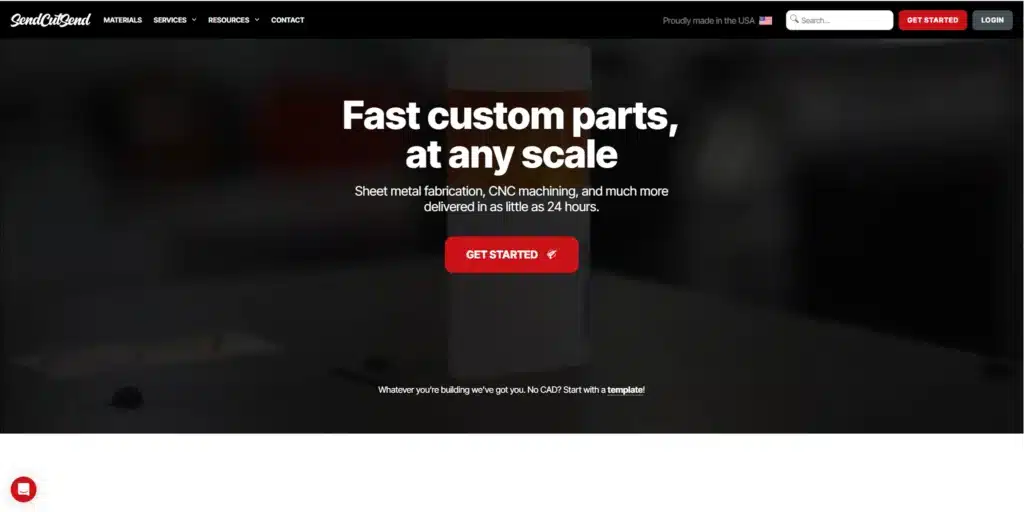
What a buyer sees. The headline reads “Fast custom parts, at any scale.” The next prompt says “Have your own file? Upload it now to see instant pricing!” The page lists the file types it takes, from .dxf to .step. Without a CAD file, “No CAD? Start with a template!” leads to a parts builder.
Further down the homepage, one plate is priced at three quantities. A 3.6 by 2.5 inch plate in .187 inch 5052 aluminum, laser cut and deburred, costs $9.41 for one, $4.82 each for ten and $3.20 each for 100. The page calls these “general estimates.”
Why it works. An engineer can test the price curve before uploading anything. Three numbers answer the first two questions, what this costs and how fast it gets cheaper. The “100% money-back guarantee” and the footer link to NET 30 payment terms answer the next two, what happens if a part comes out wrong and how a business pays. Its FAQ adds that Formal Quotes “make it easy to send a link” to whoever approves the order.
What to borrow. Pick one part you make often and price it at three quantities. Put the table on your quote page with a line saying real quotes depend on the file. A 20-person shop can pull these numbers from jobs it has already quoted. Keep the quote form itself to what you need to price the job, the file, the material and the quantity, and ask for the rest after the price.
Xometry, custom parts through a network of shops
Xometry takes orders for custom parts and routes them to manufacturers in its partner network. Its About page says the company was founded in 2013 and held its IPO in June 2021. Its how-it-works page counts “4,500+ manufacturers” in that network.
Sells. Custom parts made by partner shops.
Buyers. Engineers and the purchasing staff who pay for parts.
Page to study. How Xometry works.
Checked. 3 November 2026.
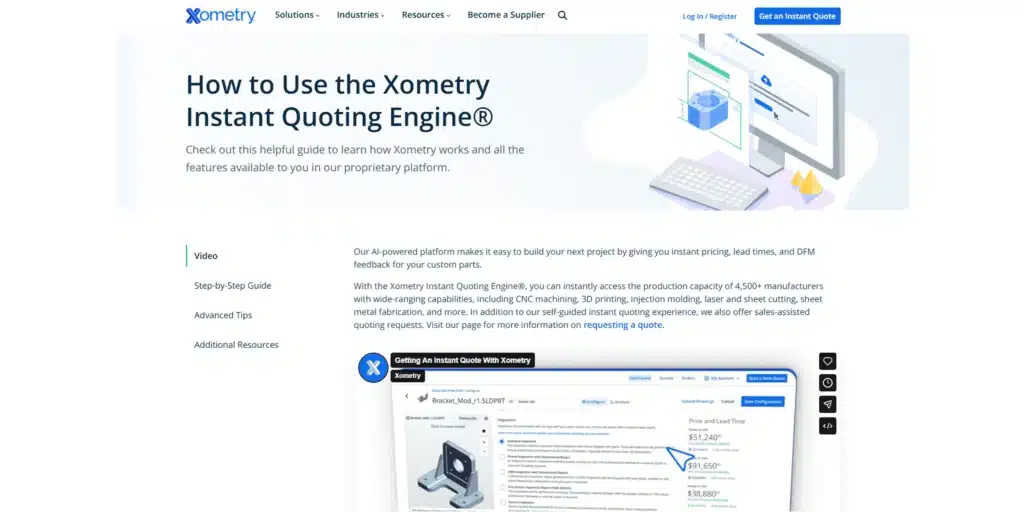
What a buyer sees. Upload a part and the page promises “instant pricing, lead times, and DFM feedback.” The next step is the one built for B2B. You can share the quote “with a purchaser or team member using the ‘Forward to Purchaser’ button.” The same page says businesses “can qualify for credit terms, allowing them to place orders with purchase orders (PO) under NET payment terms.” The footer lists ISO 9001, ISO 13485, AS9100D, IATF 16949, ITAR and CMMC Level 2.
Why it works. The engineer who builds a quote is often a different person from the one who pays for it. Xometry designs for that hand-off, so nobody has to copy numbers into an email. The certification list does the same job for the quality manager who approves suppliers.
What to borrow. Add a “send this quote to your buyer” link to every quote you email. Say on the page that you accept purchase orders, and list your certifications by name. Our guide to B2B website design best practices covers more ways to write for the second reader.
Protolabs, custom parts with an instant quote
Protolabs makes custom parts and says it was “Founded in 1999.” Its About page gives an address in Maple Plain, Minnesota. It also runs Protolabs Network.
Sells. Custom parts.
Buyers. Product engineers and designers.
Page to study. Sheet metal design guidelines.
Checked. 3 November 2026.
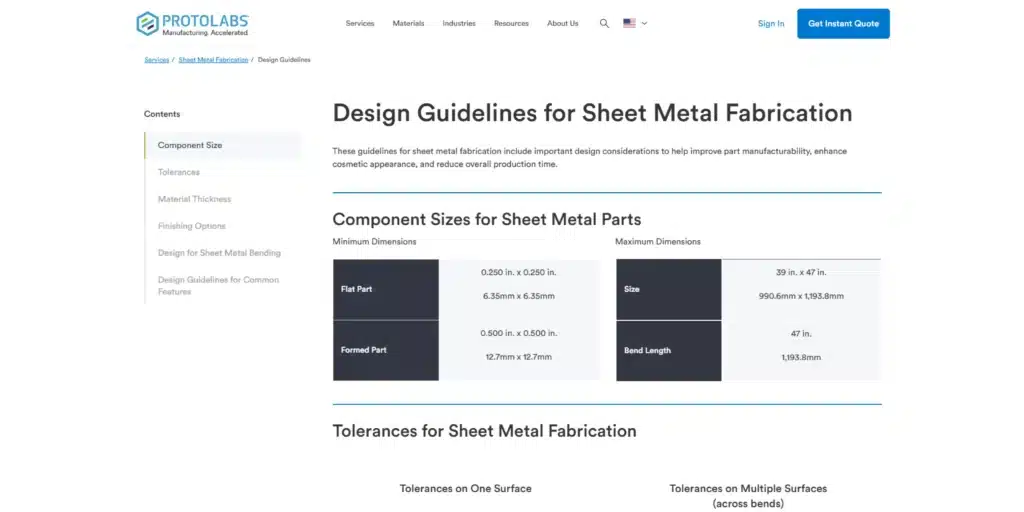
What a buyer sees. The header button says “Get Instant Quote.” The guidelines page opens with sizes and tolerances in plain tables. A flat part can be as small as 0.250 by 0.250 inches, and a formed part 0.500 by 0.500 inches. Edge to edge tolerance is 0.005 inches for material under .13 inches thick. No form stands in front of the page. The long plastic manufacturing guide in the resources section is open too.
Why it works. Engineers design to a shop’s limits. When the limits are public, the files that arrive are easier to make and faster to quote. Open guides also give the sales team something useful to send after a call.
What to borrow. Write down the five rules your shop repeats on every job, such as minimum hole size, bend radius or tolerance. Put them on one public page with no form, and treat spec sheets the same way. A form in front of a spec sheet stops the engineer who was about to send you a file. Link that page from your quote form.
Distributor and wholesale websites
Distributors win on the second order. A buyer who knows the part number wants it in the cart fast, on terms the company already approved. B2B ecommerce is its own build, with price tiers, trade accounts and reorder lists. These three put reordering and payment terms where a returning buyer looks first.
McMaster-Carr, an industrial parts catalog
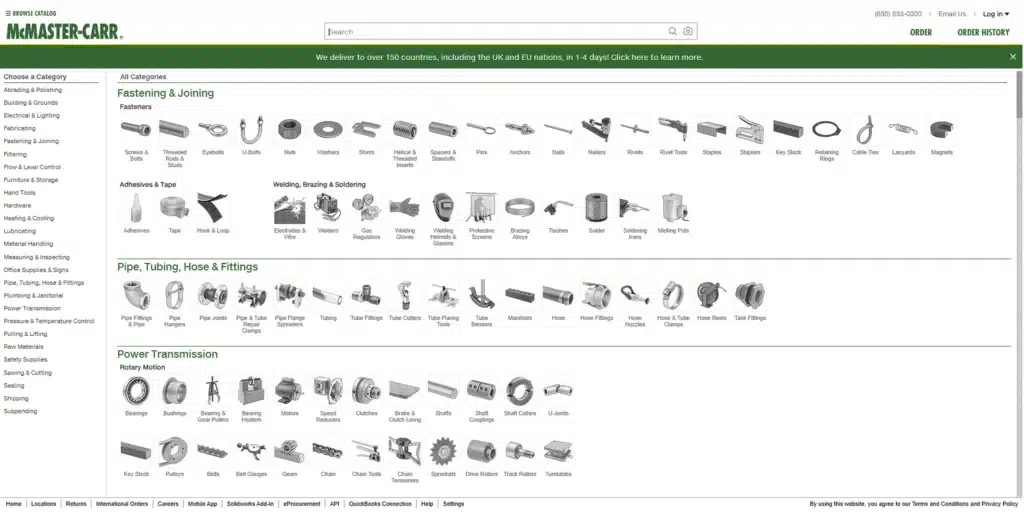
McMaster-Carr sells industrial parts and supplies through a catalog website. The homepage is the catalog itself, a list of product categories under a short header.
Sells. Industrial parts and supplies.
Buyers. Maintenance staff, plant engineers and purchasing teams.
Page to study. Homepage header and catalog.
Checked. 3 November 2026.
What a buyer sees. The header holds a phone number, (630) 833-0300, an “Email Us” link, a search box, “Order” and “Order History.” Below it sit the product categories. A buyer can start any of three jobs from the top of the page without scrolling.
Why it works. A buyer who needs the same part again opens order history. A buyer who needs a new part searches. A buyer with a problem calls. All three paths sit in one line. A page made mostly of text and links also has little to slow it down, and speed matters to search engines as well as buyers, as our guide to SEO-friendly web design explains.
What to borrow. Put “Reorder” or “Order history” in your header, next to a phone number a person answers. If your catalog lives in a PDF, start with a search box over a simple parts list.
Worth knowing. The catalog works best for buyers who already know the part they need, which is why the phone number sits at the top for everyone else.
Zoro, tools and supplies for businesses
Zoro sells tools, parts and supplies online. Its tagline is “Tools, parts, and supplies for your business™.”
Sells. Tools, parts and supplies.
Buyers. Business buyers, from office managers to maintenance leads.
Page to study. Homepage account box and Quick Order.

Checked. 3 November 2026.
What a buyer sees. The header carries a “Quick Order” link. The account box on the homepage gives three reasons to sign in. “Free shipping $50+.” “Access to Net 30 terms.” “Easy reordering.” The footer lists a phone number under the line “Customer service from real people.”
Why it works. Net 30 is the phrase that tells an office manager this site fits how the company pays. Zoro states it on the homepage, long before checkout. Quick Order lets a buyer with a list of part numbers skip browsing.
What to borrow. Write your payment terms on the homepage in your buyers’ words, such as Net 30 or “pay by invoice.” If you take orders by email today, add a short order form with part number and quantity fields, and name the person who replies.
Worth knowing. The Net 30 line sits in the sign-in box, so the terms come with a business account rather than a first visit.
Faire, wholesale for independent retailers
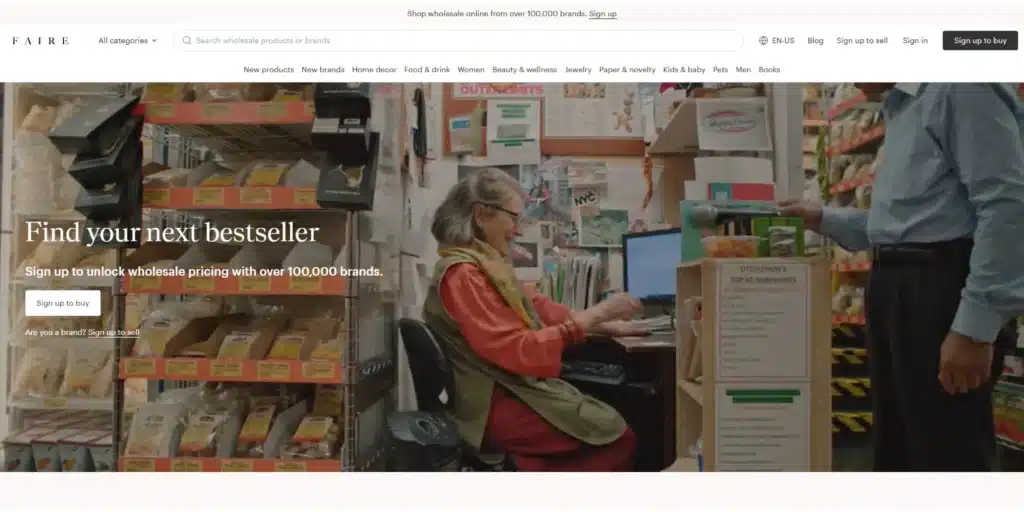
Faire connects independent retailers with brands that sell wholesale. Its homepage offers retailers who sign up “wholesale pricing with over 100,000 brands.”
Sells. Wholesale access to brands.
Buyers. Independent retail shops.
Page to study. Homepage.
Checked. 3 November 2026.
What a buyer sees. The homepage leads with money and risk. Under “Take 60 days to pay,” it says “Invoices aren’t due for 60 days, interest-free, so you have time to sell before you have to pay.” Under “Keep what sells, send back the rest,” it adds “The first time you order from a brand, you can return what doesn’t sell straight to Faire at no cost to you.”
Why it works. A shop owner trying a new brand worries about cash and about stock that sits on the shelf. Faire answers both before showing a single product. For this buyer, the terms are the offer.
What to borrow. List the three things that make a first order with you low risk, such as small minimums, trial terms or returns. Put them above your product list. If you cannot offer 60 days, state what you can offer in plain numbers.
Worth knowing. The terms apply to retailers who sign up, so these pages speak to independent shops more than to chain buyers.
Professional services websites
Services firms sell people and judgment, so a buyer cannot inspect the product first. These three cut the risk of the first conversation in different ways. One shows the process, one gives away a tool, and one publishes a price.
Toptal, freelance talent for companies
Toptal places freelancers with client companies. Its how-it-works page says “Toptal Connects the Top 3% of Freelance Talent All Over The World,” which is the company’s own claim.
Sells. Access to screened freelancers.
Buyers. Hiring managers and founders.
Page to study. How it works.
Checked. 3 November 2026.
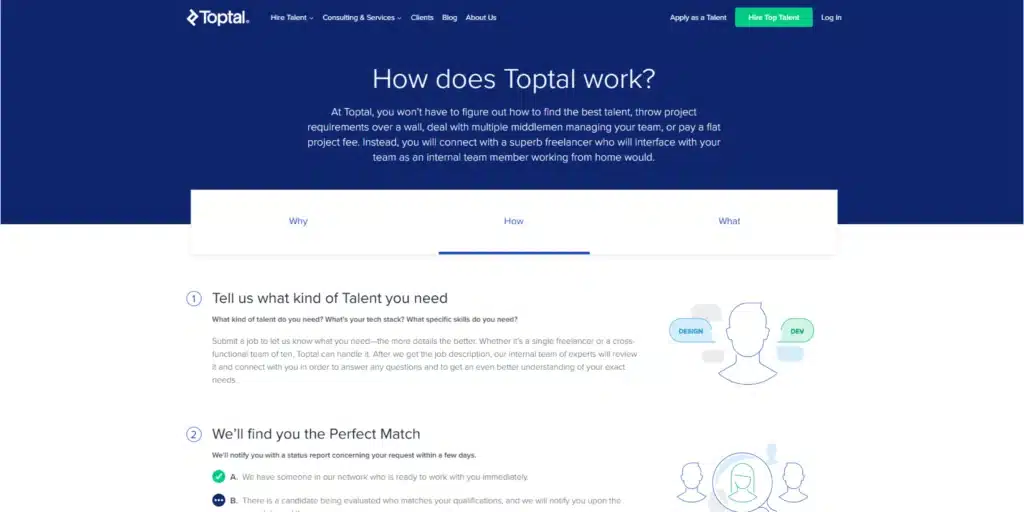
What a buyer sees. Four steps, each with a short heading. “Tell us what kind of Talent you need.” “We’ll find you the Perfect Match.” “They become part of your Team.” “Work with them at No-Risk.” The page promises a “status report concerning your request within a few days,” and its trial terms include the line “you will not be liable for any payment.”
Why it works. Hiring a stranger feels risky. The four steps tell the buyer what happens after the form, and the trial moves the risk to Toptal. The timing promise is modest, a few days, which makes it easy to believe.
What to borrow. Write your process as three or four steps a client can picture, with what they do and what you do at each one. Add one risk reducer you can keep, such as a short paid trial or a fixed-price first project.
Worth knowing. The how-it-works page shows no rates, so a buyer still needs a conversation to learn the cost.
Cooley GO, free legal documents from a law firm
“Cooley GO is a project of Cooley LLP,” and the firm launched it on 1 July 2014. Cooley has “nearly 1,400 lawyers across 19 offices in the United States, Asia and Europe.”
Sells. Legal services from Cooley LLP, with Cooley GO as the free resource site.
Buyers. Startup founders.
Page to study. Documents.

Checked. 3 November 2026.
What a buyer sees. A library of templates and generators under the line “Fast forward using our document generator.” The list includes a Delaware incorporation package, an advisor agreement, NDAs for the US, UK and Singapore, and an employee offer letter.
Why it works. A founder who generates an advisor agreement has used the firm’s work before paying for any of it. The tool is useful on its own, and every clause shows the firm’s judgment. When the company later needs a lawyer, it already knows one firm’s work.
What to borrow. Pick one document your clients always ask for, such as a scope template, a checklist or a calculator. Make a free version that works with no call. Our design brief template is our own small version of this idea.
Worth knowing. The generators lean on US documents, with NDAs for the UK and Singapore, so firms elsewhere still need local advice.
Pilot, bookkeeping, tax and CFO plans
Pilot sells bookkeeping, tax and CFO services to businesses. Its About page lists a San Francisco HQ and a Nashville HQ.
Sells. Bookkeeping, tax and CFO plans.
Buyers. Founders and finance leads at growing companies.
Page to study. Pricing.
Checked. 3 November 2026.
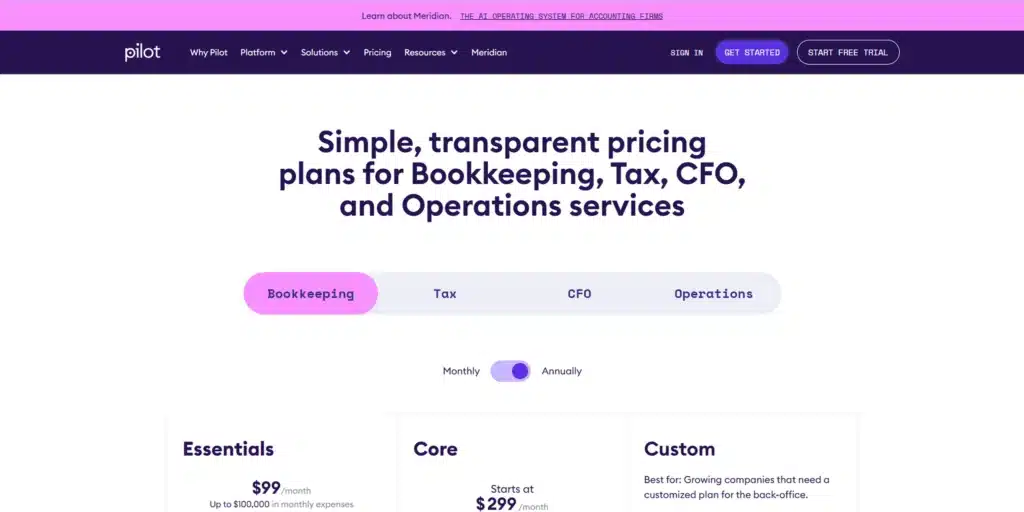
What a buyer sees. Three plans. Essentials is “$99 /month” for businesses with “Up to $100,000 in monthly expenses.” Core “Starts at $299 /month billed annually,” a figure the page shows with its slider at $9,000 in monthly expenses. Custom has no price. Each plan lists its work in plain terms, such as a “Year-end package for your tax preparer” or “Reports on the 10th business day.”
Why it works. Bookkeeping costs depend on volume, so one flat price would be wrong for half the buyers. Pilot ties the price to a number the buyer already knows, monthly expenses, and lets them move a slider. The buyer leaves with a range before talking to anyone.
What to borrow. Find the one input that drives your price, such as hours, units or locations. Publish a starting price tied to it, and put the condition right next to the number.
Worth knowing. The Core figure is billed annually and moves with the slider, so the price a buyer sees depends on the expenses they enter.
Software sold to industries outside tech
Search for the best website design for technology companies and the results are full of software sold to other tech teams. If that is your market, our SaaS website examples cover it. The three companies below sell to construction firms, fleets and restaurants, buyers who judge software by how well it fits their trade. These are the best website designs for B2B technology companies whose buyers do not work in tech.
Samsara, operations software for fleets and field work
Samsara sells software for organizations that run vehicles and field operations. Its About page lists a San Francisco HQ.
Sells. Operations software.
Buyers. Fleet, construction, food and public sector operators.
Page to study. Industries.
Checked. 3 November 2026.
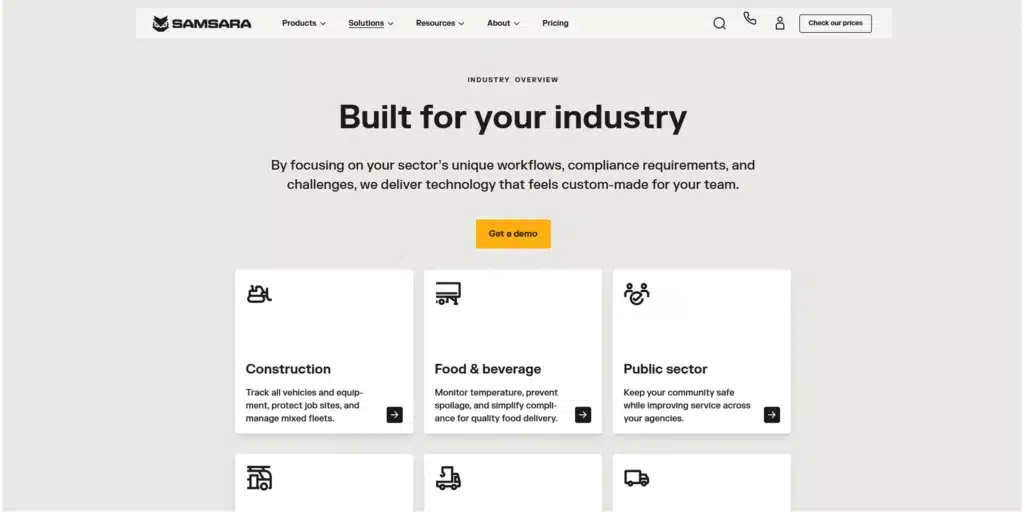
What a buyer sees. A page headed “Built for your industry” with six tiles. Construction, Food & beverage, Public sector, Passenger transit, Field services and Transportation & logistics. Each tile has one line and a “Learn More” link. The two calls to action are “Get a demo” and “Talk to sales.”
Why it works. A construction operations manager scans for the word construction. Naming each trade in the menu lets a buyer find their own page in one click. The page behind each tile can then speak that trade’s language.
What to borrow. List your three biggest customer industries in your main menu, each with its own page. Write each page around one problem from that trade, in the words its people use.
Worth knowing. The page ends in a demo or a sales call and shows no prices.
Procore, construction management software
Procore sells software for managing construction projects. Its US site has separate pages for general contractors, owners and subcontractors under a “Who We Serve” menu.
Sells. Construction management software.
Buyers. General contractors, owners and subcontractors.
Page to study. General contractors page.

Checked. 3 November 2026.
What a buyer sees. Each role page opens with its own headline. General contractors read “The #1 end-to-end construction management solution for GCs.” Owners read “Capital portfolio management, one connected platform.” Subcontractors read “Subcontractor Management Software.”
Why it works. Three roles on one job site want different things from the same software. The owner watches a portfolio of projects and budgets. The general contractor runs the job day to day. One page per role lets each buyer read about their own work in their own terms.
What to borrow. If two kinds of people sign off on your sale, write a page for each. Start with the headline, and use the job title they put on their business card.
Worth knowing. The role pages above are on the US site. Visitors from other regions may land on a local version with different labels.
Toast, point of sale for restaurants
Toast sells point-of-sale systems, payroll and related software to restaurants. Its pricing page notes that “Toast is not a payment card processor, but it is a payment facilitator.”
Sells. Restaurant point of sale and related software.
Buyers. Restaurant owners and managers.
Page to study. Pricing.
Checked. 3 November 2026.
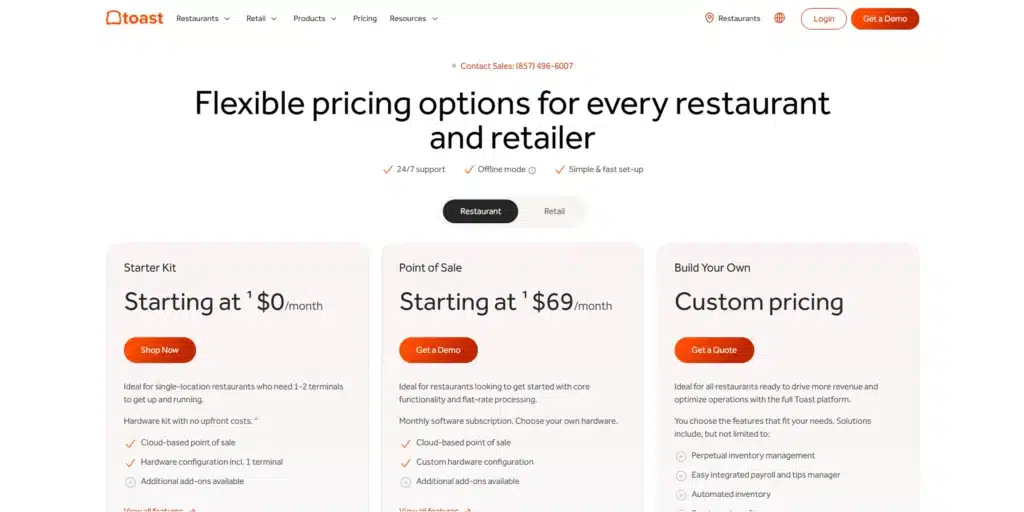
What a buyer sees. Plans start at “$0 /month” for the Starter Kit and “$69 /month” for Point of Sale, with a custom Build Your Own option. Payroll adds “$69/month + $9 per employee/month.” Then the page lists what costs extra. “The upfront costs for Toast are hardware and implementation.” “Pricing applies to new customers and single locations only.” “Additional charges apply for subsequent devices.” A note at the bottom says the page was last updated on 20 August 2026.
Why it works. A restaurant owner comparing systems wants the full cost, and surprise fees kill trust. Toast names the extras before the sales call, which makes the starting price believable. The update date tells the buyer the numbers are current.
What to borrow. Next to any price you publish, list what it leaves out. Add the date you last checked it. Both take a few lines and save a call.
Worth knowing. The prices apply to new customers and a single location, so a restaurant group should expect a custom quote.
What these twelve websites have in common
Five patterns repeat across the twelve, and none of them depends on budget. A site counts for a pattern only if its own profile above shows it. We did not count anything we did not see on the page we studied, so the real numbers may be higher. Treat the counts as a floor.
A path to a number before a call
Four of the twelve put a number on custom work or a plan before anyone talks to sales. SendCutSend prices a sample plate. Xometry promises instant pricing. Pilot and Toast publish starting prices with conditions.
The research behind this is old and still holds. “Business customers report pricing as the top most needed piece of information online,” Hoa Loranger wrote for Nielsen Norman Group on 1 December 2013. Her team watched test participants “go to competitors’ sites when websites do not show prices.”
Custom work makes this harder, because no two orders cost the same. For work that has no fixed price, Jakob Nielsen’s advice from 9 April 2006 still fits. Help buyers “by showing sample prices for a set of typical orders.” SendCutSend’s three-quantity plate is that advice in practice, and Pilot’s slider is a more elaborate version of the same idea. Our guide to SaaS pricing page design walks through the layout side of this.
The working page gets the design budget
On three sites, the page buyers return to is the center of the design. McMaster-Carr’s homepage is its catalog. Zoro puts Quick Order in the header and reordering in its account box. Cooley GO’s main draw is its document generator. We think the page buyers work on deserves the design budget before the homepage does.
Proof a reviewer can check
Four sites back their claims with something a skeptical reader can test. Xometry lists its certifications by name. SendCutSend offers a money-back guarantee. Faire promises free returns on a first order and 60 days to pay. Toptal describes a trial with no payment if it fails. A logo wall asks the reader for trust. These let the reader check.
The buyer’s own words in navigation
Samsara names industries, and Procore names roles. Both let a buyer find themselves in one click, using the word they would type into search.
A route for the second person
Four sites design for the person who did not start the visit. Xometry has its “Forward to Purchaser” button and purchase order terms. SendCutSend says its Formal Quotes “make it easy to send a link.” Zoro offers Net 30, and Faire offers 60-day invoices, both written for whoever pays the bills.
What looks good in a gallery and fails a B2B buyer
A gallery judges the best B2B website design by its first screen. A buyer judges it by the third visit, when they need to reorder, forward a quote or check a price.
Five habits look good in a screenshot and cost a B2B buyer time.
- An autoplay hero video on a parts site, pushing the search box down the page.
- A quote form with a dozen fields and no place to upload a file.
- Spec sheets locked behind an email form.
- Product pages with no dimensions or materials.
- Stock photos of people shaking hands.
Each page in this list earned its place by what a buyer can do on it. Several look simple in a screenshot, and that simplicity is part of why they work.
If your redesign brief starts with “make it look modern,” add a second line. Name the task a returning buyer should finish in under a minute, and design that page first.
If you are a small B2B company
You do not need Xometry’s quoting engine to borrow its idea. Each pattern above has a version a small company can build.
- Example prices in place of a quote engine. Publish prices for three typical orders, or a typical range, with the conditions next to them. Our own pricing page lists a weekly design plan at $1,500 and monthly plans from $2,990.
- A quote form that takes a file. Ask for the file, the material and the quantity, and say on the form when you will reply.
- A quality page. If you hold certifications, list them by name and let buyers download the certificates.
- A simple reorder path. A short reorder form, or an “order again” link in your order emails, is the first step toward a customer portal.
- One page per main market. Start with your two or three biggest customer types, each with its own page, before you build a full industry menu.
- One free tool or template. Pick the document clients always ask for and give it away. Our free design brief template is our own example.
If you can only do one a month, start with the first two. They change what a buyer can do on your site. The rest change how much buyers believe it.
Trust is the hard part when you have no famous logos. A plain About page with real names, photos and a clear history does more than a logo wall. Our B2B About Us page examples show how small firms handle that page.
How to use these examples on your own site
Use the list as a working tool, in four steps.
- Find your group. Decide how you sell, by quote, catalog, retainer or demo, and start with the group above that sells the same way. Ignore what websites in your industry usually look like.
- Pick the page buyers use most. Check Search Console or your analytics for the page returning buyers open most, often the quote form, catalog or pricing page. Rebuild that page first.
- Watch three customers use it. Ask three customers to finish one real task on that page while you watch. Note every field they skip, every click that goes nowhere and every question they ask.
- Write it into a brief. Describe the change, the buyer it serves and the small version you will build first. If you are rebuilding the whole site, our website redesign checklist covers the rest.
How Pixelean designs B2B websites
Pixelean designs and builds B2B websites on WordPress, Webflow and Framer. Our rule is to start with the page buyers work on, the quote form, catalog, pricing page or process page, and design the homepage after it. We write the page in the buyer’s words, put a number or a clear next step where they look first, and keep the proof checkable.
You can read about our web development services or see our plans and prices.
Frequently asked questions
What is an example of a B2B website?
A B2B website is a website a company uses to sell to other businesses. McMaster-Carr is a clear example. It sells industrial parts, and its homepage is a searchable catalog with order history and a phone number in the header. Other examples include SendCutSend for custom metal parts, Pilot for bookkeeping and Procore for construction software.
What is the difference between a B2B website and a B2B ecommerce website?
A B2B website explains and sells a business offer, and the sale may end in a quote, a contract or a call. A B2B ecommerce website is one that lets buyers order and pay online, often with account pricing, reorder lists and invoice terms. Zoro and McMaster-Carr are ecommerce. Toptal and Cooley GO are not.
What makes a manufacturing company website good?
A good manufacturing company website gets an engineer from a drawing to a price. Good sites accept the buyer’s file types, show sample prices or an instant quote, publish design rules and list certifications by name. SendCutSend, Xometry and Protolabs each do several of these on public pages.
Can a small B2B company compete with these websites?
Yes, on the pages that matter to buyers. A small firm cannot match a large catalog, but it can publish sample prices for three typical orders, state its payment terms, list its certifications and offer one free tool. None of these needs custom software, and each answers a question buyers ask before calling.
Where can I find more B2B website design inspiration?
Start with companies that sell the way you do, and use design galleries last. Galleries such as Awwwards, Land-book and Dribbble show how sites look, and they say nothing about quotes, orders or calls. Study the quote pages, catalogs and pricing pages of firms in your group, including suppliers you buy from.
The bottom line
Sort B2B website examples by how a company sells, and they become useful. A machine shop learns from SendCutSend’s sample prices and Xometry’s forward button, and gains little from a software homepage. A distributor learns from McMaster-Carr’s header and Zoro’s terms. A services firm learns from Toptal’s steps, Cooley GO’s free tool and Pilot’s starting price. The twelve sites share one habit. They give the page buyers work on the best design attention and leave the homepage to point there. Find the group that sells the way you sell, and copy the page that does the work.
Want a second opinion on your site? Send us your website. We will reply with the page we would rebuild first and the small version of one pattern from this post that fits how you sell. Get in touch.
Sources
All company pages were read on 3 November 2026.
- Hoa Loranger, “State the Price to Give B2B Sites a Competitive Advantage,” Nielsen Norman Group, 1 December 2013.
- Jakob Nielsen, “Show Prices for Common Scenarios,” Nielsen Norman Group, 9 April 2006.
- SendCutSend homepage.
- Xometry, How Xometry Works and About Us.
- Protolabs, About Us and Sheet Metal Design Guidelines.
- McMaster-Carr homepage.
- Zoro homepage.
- Faire homepage.
- Toptal, How It Works.
- Cooley GO, About and Documents.
- Cooley LLP, “Cooley Launches ‘Cooley GO’, a New Resource for Entrepreneurs,” 1 July 2014.
- Pilot, Pricing and About.
- Samsara, Industries and About.
- Procore, General Contractors, Owners and Subcontractors pages.
- Toast, Pricing.